Franz Groll
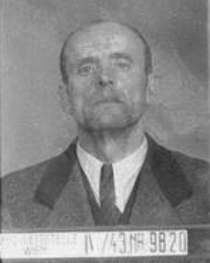
Personalia
Born:
Died:
Profession:
Persecution:
Imprisonment April 26, 1944 – May 15, 1944,
Imprisonment May 16, 1944 – July 9, 1944,
Dachau Concentration Camp July 9, 1944 – August 25, 1944,
Flossenbürg Concentration Camp August 25, 1944 – November 15, 1944,
Murdered on November 15, 1944
KZ Number:
Curriculum Vitae
Franz Samek was born in Vienna as the illegitimate son of Franz Groll, a streetcar driver of the same name, and Maria Samek. Two years after his birth, his parents married, and the child took his father’s surname. Nothing is known about his childhood and youth. As an adult, Franz Groll followed in his father’s footsteps and joined the Vienna Public Transportation Authority as a streetcar driver. Although he held communist views, he was not politically active in the 1920s and 1930s. In 1923, he married Maria Gstottner, but the marriage remained childless.
On March 12, 1938, Franz Groll witnessed the demise of free and independent Austria with the invasion of the German Wehrmacht. Even in occupied Austria, he remained an employee of the Vienna Public Transportation Authority. In November 1938, he left the Catholic Church.
In 1944, Franz Groll listened to foreign radio stations, so-called “enemy stations,” which led to his imprisonment from April 26, 1944, until May 15, 1944, for “violating the Broadcasting Ordinance.” On the day of his release, he told close relatives who were members of the Nazi Party that the war would be lost in September 1944 and that they would then be held accountable.
Groll was not released until May 15, 1944, after 21 days of protective custody for violating the Broadcasting Ordinance and following a stern warning from the state police; upon returning to his apartment, he made the most serious threats against his family members, who held National Socialist views, stating that the war would be lost for Germany in September 1944 and that “they would then have to face the consequences.”
Since G. is an incorrigible and fanatical Marxist, he will be sent to a concentration camp.
His close relatives denounced Franz Groll, and he was arrested again on May 16, 1944—just one day after his release from prison. Without interrogation or trial, he was deported to the Dachau concentration camp on July 9, 1944, on charges of “anti-state statements.” From there, he was transferred to the Flossenbürg concentration camp on August 25, 1944, where he was murdered on November 15, 1944.
His wife, Maria Groll, received official notification of his death on December 11, 1944, stating that Franz Groll had died of myocarditis.
Maria Groll witnessed the liberation of Austria and the restoration of the republic in April and May 1945, respectively, and joined the newly founded Austrian People’s Party (ÖVP) and the ÖVP Fellowship of the Politically Persecuted and Defenders of Austria.
Places
Residence:
Persecution:
Death Place:
Citations
Wiener Stadt- und Landesarchiv (WStLA)
Dokumentationsarchiv des österreichischen Widerstands (DÖW)
Matricula Online
