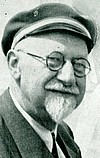
Ministerialrat Dr. Julius Kallus
Personalia
Born:
Died:
Profession:
Persecution:
Imprisonment May 25, 1938 – June 16, 1938,
Dachau Concentration Camp June 16, 1938 – September 22, 1938,
Release 1938,
Resistance fighter (undetected)
KZ Number:
Honors:
Ring of Honor from the Austrian Cartellverband (ÖCV)
Memberships
Curriculum Vitae
Julius Kallus was born in Korneuburg as the legitimate son of Julius Kallus, a ship’s steward with the Danube Steamship Company (DDSG), and his wife Marie, née Fetty. After attending elementary school in Korneuburg, he attended the teacher training college in St. Pölten from 1900 to 1906 and initially worked as an elementary school teacher in Floridsdorf. In 1907, he joined the Danubia fraternity. Julius Kallus also played a role in the founding of the Markomannia secondary school fraternity (now Marko-Danubia) in Korneuburg in 1908. Since the graduation certificate from the teacher training college was not yet fully recognized as qualifying for university studies at that time, he earned his high school diploma at the Stiftsgymnasium in Klosterneuburg in 1912.
In 1916, he earned his doctorate in philosophy, but was unable to take the teacher certification exam until 1918 due to his military service. Julius Kallus was appointed professor at the Teacher Training College in Linz and, beginning in 1923, to the Reform Department of the Federal Ministry of Education. In 1927, he played a key role in founding the Kreuzenstein Secondary School Alumni Association. He married Leopoldine Fleischer-Haider and subsequently became the father of three children.
In the years that followed, Julius Kallus played a key role in the restructuring of the school system and distinguished himself through numerous scholarly publications. During his tenure at the ministry, he also authored the history textbook *History Textbook for Teacher Training Colleges*, in which he revealed his views on Nazi ideology shortly after the Nazis came to power in Germany.
Julius Kallus rejected the rising National Socialism because of its contempt for humanity, atheism, and pan-Germanism. He recognized early on that this ideology was geared toward war and dictatorship.
[…] an enthusiastic return to ancient Germanic paganism […] rejects, more or less openly, Christianity as an outgrowth of a foreign Semitic spirit; […] the un-German concept of ‘myth’ […] is intended to serve as a substitute for the individual who has lost his faith and for the community as a whole, replacing what religion sets as its ultimate goal and destiny.” Regarding National Socialism’s relationship to Austria, he elaborated: “[…] Without any regard for Austria’s mission in the Danube region, without any appreciation for the values inherent in the distinction between national and supranational concepts of the Reich, he attempted to force the violent annexation of Austria through a revolution from within.”
On March 12, 1938, the Austrian Catholic patriot witnessed the downfall of a free and independent Austria with the invasion of the German Wehrmacht. The Nazis disapproved of his fundamental ideas, as outlined in his history textbook, and he was arrested at his workplace on May 25, 1938. Via the police jail on Elisabethpromenade, he was transferred to the Dachau concentration camp on June 16, 1938, where he was held for three months. After his release on September 20, 1938, Julius Kallus was forced into retirement and was required to report regularly to the Gestapo. Since he was barred from practicing his profession, he devoted himself to a settler community in Floridsdorf that he had helped found. He became active in the resistance group “Geheimgruppe Dr. Lerch” led by Gottfried Lerch. His involvement in the resistance went undetected.
In Vienna, Julius Kallus witnessed the liberation of Austria and the restoration of the Republic in April and May 1945, respectively. He joined the newly founded Austrian People’s Party (ÖVP) and the ÖVP Association of the Politically Persecuted and Defenders of Austria. As a civil servant, he was rehabilitated but retired in 1946 upon reaching the mandatory retirement age. Afterward, he worked, among other things, as a freelance contributor to the weekly magazine “Die Furche.” He became an honorary member of several other secondary school alumni associations.
Julius Kallus died at the age of 73 and was laid to rest at the cemetery in Vienna-Döbling.
Places
Persecution:
Residence:
Honoring:
Citations
Wiener Stadt- und Landesarchiv (WStLA)
Fritz, Herbert/Krause, Peter (2013): Farbe tragen, Farbe bekennen 1938–45. Katholisch Korporierte in Widerstand und Verfolgung. (ÖVfStg, 2013) S. 357/358.
Julius Kallus, Hermann Käfer, Wilhelm Katzenbeißer. (1936): Lehrbuch der Geschichte für Lehrer- und Lehrerinnenbildungsanstalten (Wien)
Matricula Online
Wikipedia unter de.wikipedia.org/wiki/Julius_Kallus