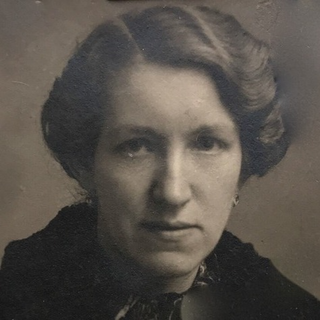
Anna Hanika
Personalia
Born:
Died:
Profession:
Persecution:
Imprisonment: August 23, 1940 – March 10, 1943
Honors:
Decoration for Services to the Liberation of Austria
Memberships
Curriculum Vitae
Anna Hanika was born in Vienna as the youngest child of businessman Karl Hanika and Theresia, née Stepan. A devout Catholic, she had a brother, Anton, and a sister, Johanna, who later joined the Order of the Carmelites. Her father died when she was six years old. After attending elementary and middle school, she took sole responsibility for supporting her mother. In 1923, she joined the Christian Social Union and worked there as a clerk [Note: commercial employee]. In 1934, she joined the Fatherland Front.
On March 12, 1938, this devout Catholic and patriotic Austrian witnessed the downfall of free and independent Austria with the invasion of the German Wehrmacht. Following the occupation of Austria, the labor unions were immediately dissolved, and Anna Hanika was dismissed. She subsequently found work at a German ball-bearing company.
Through her good friend Rudolf Wallner, deputy inspector of the Vienna Electric Works, she came into contact with the Austrian Freedom Movement led by Karl Lederer in late 1939 and joined the organization. Her duties included recruiting new members and collecting membership dues. She convinced women from her circle of acquaintances to join the movement, such as Margarete Skroch and Stefanie Wotraubek, who sang with her in the church choir. [Note: Some sources portray Rudolf Wallner as Anna Hanika’s fiancé; however, according to her foster son Gerhard Kastelic, he was merely a good friend.]
In 1940, she succeeded in establishing contact with the Austrian Freedom Movement led by the Augustinian canon Roman Karl Scholz and the Greater Austrian Freedom Movement led by Jakob Kastelic. Beginning in July 1940, some 300 members of these resistance groups were betrayed by Burgtheater actor Otto Hartmann (Otto Hartmann was subsequently sentenced to life imprisonment in 1947 and pardoned in 1957), and Anna Hanika was arrested on August 23, 1940. She spent her pretrial detention in Vienna and at the Stein penal servitude near Krems on the Danube. On March 10, 1943, she was released due to a heart condition, and in a trial before the People's Court on March 2 and 3, 1944, she was sentenced to two years in prison for “preparation for high treason,” with her pretrial detention credited toward the sentence.
Her co-defendants—Karl Lederer, Alfred Miegl, and Rudolf Wallner—were sentenced to death. She remained in contact with Rudolf Wallner and Jakob Kastelic until their executions. She also arranged for Jakob Kastelic to see his younger son, Gerhard Kastelic, during prison visits.
As early as 1943, after her release from prison, she took in the younger, motherless son, Gerhard Kastelic—son of resistance fighter Jakob Kastelic—and, following his father’s execution on August 2, 1944, also assumed the role of mother. Later, the older son, Norbert Kastelic, joined them as well. After the death of her father’s sister in 1954—who had been the guardian of the two sons of the executed Jakob Kastelic—she also assumed guardianship of the brothers, guided both to their doctorates, and served as their family until their weddings.
In Vienna, Anna Hanika witnessed the liberation of Austria and the restoration of the Republic in April and May 1945, respectively; she joined the newly founded Austrian People’s Party (ÖVP) and the ÖVP Association of the Politically Persecuted and Defenders of Austria. Anna Hanika worked to identify and bury her executed comrades-in-arms; in 1947, she testified as a witness in the trial against the traitor Otto Hartmann. Due to health reasons, she remained retired.
Anna Hanika was also active in charitable work and supported missionary efforts in Africa through more than 300 medicine drives. When her decades-long heart condition worsened, she moved to the Sisters of Mercy retirement home in Gumpendorf in 1987. She died in Vienna at the age of 84 and was laid to rest in the Kastelic family plot at the Vienna-Penzing Cemetery, which was honorarily dedicated by the City of Vienna in 2025.
Places
Residence:
Citations
Wiener Stadt- und Landesarchiv (WStLA)
Gerhard Kastelic, Privat
Wikipedia unter de.wikipedia.org/wiki/Anna_Hanika
Matricula Online
