Johann Ruggenthaler
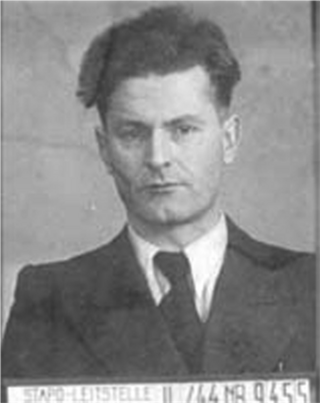
Personalia
Born:
Died:
Profession:
Persecution:
Imprisonment March 31, 1938 – May 17, 1938,
Imprisonment February 17, 1944 – April 6, 1945
Memberships
Curriculum Vitae
Johann Ruggenthaler, a native of East Tyrol, attended high school in Salzburg. After graduating from high school, he went to Vienna to study theology. In 1931, he became a member of the Bajuvaria fraternity. After his ordination in 1934, he first served as an assistant pastor and religion teacher in Liesing (23rd district), and later as a curate in Pressbaum, St. Pölten district, where he came into conflict with the new rulers shortly after the Anschluss.
He was arrested on March 31, 1938, for having made “derogatory remarks about the Führer and [the] National Socialists in front of schoolchildren” when he said that there was only one leader and that he was not in Berlin. He was initially transferred to the Korneuburg District Court and from there to the Vienna II Regional Court. In May 1938, the proceedings were dismissed. After his release, he arrived on September 1, 1938, as a curate at St. Brigitta in Vienna-Brigittenau. There, he was prohibited from holding pastoral sessions for young people. Because he did not comply with the ban, he was interrogated several times by the Gestapo.
Johann Ruggenthaler is one of the co-founders of the resistance group “League of Young Catholic Germans—Fighting League for the Christian Faith and the German Way,” which operates in the spirit of “Catholic Action” [KA]. On February 17, 1944, he was once again arrested by the Gestapo together with Fr. Josef Zeininger OSFS (1916–1995), another co-founder of the “League,” because he was alleged to have supported the efforts of this illegal, youth-movement-based, confessional youth organization, as stated, among other things, in the preventive detention order dated April 20, 1944:
“[…] his conduct endangers the existence and security of the state, as he is strongly suspected of engaging in treasonous activities on behalf of a religious youth organization affiliated with a political alliance.”
Johann Ruggenthaler was consequently charged with “preparation for high treason.” After half a year, on September 5, 1944, he was transferred from the Elisabethpromenade (“Lisl”) police jail to the Vienna I Regional Court, where, sharing a cell with Lois Weinberger and Paul Hörbiger, he witnessed the bombing raids until the end of the war, as well as the executions of his friend Walter Caldonazzi and his fellow student Heinrich Maier. His “Prison Diary” dates from this period. On April 6, 1945, he regained his freedom during the Soviet siege of Vienna.
After the war, his focus returned to university students. In 1946, he became a member of the Thuringia Vienna Secondary School Fraternity. From 1945 to 1951, he served as a youth minister and religion teacher in the St. Augustin parish and subsequently in the St. Leopold parish in Vienna II. He never lost touch with his home parish of Virgen. In 1947, he began organizing recreational trips for starving Viennese children and teenagers to his East Tyrolean homeland.
Places
Citations
- Archiv der Erzdiözese Wien
Krause, Peter/Reinelt, Herbert/Schmitt, Helmut (2020): Farbe tragen, Farbe bekennen. Katholische Korporierte in Widerstand und Verfolgung. Teil 2. Kuhl, Manfred (ÖVfStG, Wien) S. 288.
