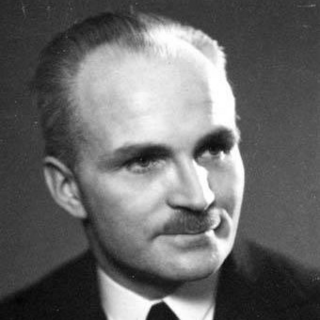
Dr. Jakob Kastelic
Personalia
Born:
Died:
Profession:
Persecution:
Released in May 1938,
Imprisoned July 23, 1940 – August 2, 1944,
Murdered August 2, 1944
Memberships
Curriculum Vitae
Jakob Kastelic was born in Vienna, the son of a baker’s apprentice, in Vienna’s 14th district. After elementary school, he attended the Imperial and Royal State Gymnasium on Fichtnergasse. In October 1915, he passed the so-called “war matura” with honors. Later that same year, he was drafted into military service and was discharged from the war with the rank of second lieutenant.
After the war ended, he enrolled in the law program at the University of Vienna and earned his doctorate in 1924. His professional career got off to a very difficult start. In the 1920s and 1930s, it was difficult to secure a good position. Jakob Kastelic worked as a legal consultant for various Catholic organizations. From 1934 to 1938, he worked full-time on the establishment and expansion of the state-run Austrian Labor Service. Beginning in 1935, the Labor Service was part of the Federal Ministry of Social Administration.
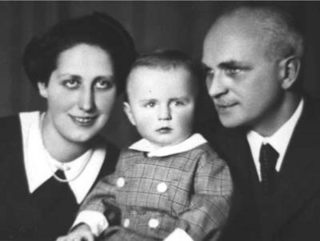
In 1937, Jakob Kastelic married the daughter of a barber from Penzing. In 1938, his eldest son, Norbert, was born, followed two years later by his second son, Gerhard.
Politically, Jakob Kastelic was firmly rooted in Austrian Catholicism. He became involved in Catholic youth organizations at an early age, including the Kalasantines, and devoted himself particularly to young workers. He was active in various organizations, such as the Fatherland Front and the “Christian-German Gymnasts” [today: Sportunion].
Following the Third Reich’s occupation of Austria, the lawyer was dismissed in May 1938. He subsequently worked as a law clerk in the law office of attorney Karl Schreiner on Vienna’s Mariahilfer Straße. A staunch opponent of National Socialism, he soon sought contact with like-minded individuals after the invasion, as well as with former political opponents—he accepted all groups except the Communist Party of Austria (KPÖ)—whom he knew would not, at that time, support action against the National Socialists, since the Third Reich was still allied with the USSR. A first meeting took place in November 1938 at Café Wunderer on Hietzinger Bridge. He gradually established resistance cells and named the resistance group the “Greater Austrian Freedom Movement.”
Among the group’s political goals was the idea of a Danube Federation that would include Bavaria, if possible with the participation of the House of Habsburg. Among Kastelic’s fellow activists were the Social Democratic journalist Hans Schwendenwein, the independent Karl Rössel-Majdan, and the writer Günther Loch. In 1940, he succeeded in establishing contact with the “Austrian Freedom Movement” led by Karl Lederer and with the group centered around the Augustinian canon Roman Karl Scholz.
Beginning in July 1940, some 300 members of these resistance groups were betrayed by the Burgtheater actor Otto Hartmann (Otto Hartmann was subsequently sentenced to life imprisonment in 1947 and pardoned in 1957), and Jakob Kastelic was arrested on July 23, 1940. In December 1940, he was admitted to the Vienna Regional Court; in the summer of 1941, he was transferred to the Anrath Penitentiary in Westphalia, then sent to the Hamborn Penitentiary, and in January 1943, he was transferred back to Anrath. On March 1, 1944, Jakob Kastelic was sentenced to death by the People's Court for high treason.
On January 24, 1941, Jakob Kastelic was informed at the Vienna Regional Court that his wife was seriously ill. He was taken to see his wife that same day. Over the next two days, he heard nothing about his wife’s condition. Another day later, he learned that his wife had died two days earlier. His wife, Maria, thus died on January 25, 1941. The cause of death was pneumonia and pleurisy.

The Nazis did not allow Jakob Kastelic to attend his wife’s funeral. One hour before the funeral, he was permitted—under the watch of two judicial officers—to say goodbye to his deceased wife in the funeral parlor.
Pleas for clemency from his sister Anna and his mother, who was 84 at the time, were rejected by the Vienna Gauleiter, Baldur von Schirach.
On August 1, 1944, Jakob Kastelic receives one last visit. He is not told the date of his execution. Among the visitors are Anna Hanika and his son Gerhard, who is a toddler at the time. Also present is Father Johann Bruckner, a friend of the family, who knows that the death sentence is to be carried out the following day.
His son Gerhard and Father Bruckner were not permitted to enter the visiting room during the visit. The entrance door was opened for a brief moment so that Jakob Kastelic could see his son and Father Bruckner one last time. The priest grants him general absolution, for which the prisoner expresses his gratitude with a deep bow. But the voice of the guard, announcing the “end of visiting hours,” brings the visit to a close without allowing for a final farewell.
Jakob Kastelic was murdered by guillotine on August 2, 1944, at the First Regional Court in Vienna. His body was found in the Vienna Anatomical Institute after the war ended in 1945. He was buried on October 27, 1945, at the Penzing Parish Cemetery.
From his farewell letter dated August 2, 1944, the day of his execution:
My dearest, faithful little sister!
Take care of my darlings; raise them to be upright, good people. My deepest thanks for all your love and kindness! Make Mother’s twilight years beautiful! Spare her from the terrible news of my death in this manner! May she come to me in eternity with a beautiful image of me. With the deepest gratitude, I go into eternity strengthened by this means of grace. Your image accompanies me on my final journey. My deepest thanks to all my dear relatives and in-laws, benefactors, friends, and acquaintances! My special thanks and greetings go to the dear foster mothers of my little boys!
With deepest love, your Jakob
Places
Residence:
Honoring:
Memorial:
Death Place:
Citations
Homepage "Zur Erinnerung" unter www.jakob-kastelic.zurerinnerung.at