Friedrich Karas
Personalia
Born:
Died:
Profession:
Persecution:
Imprisonment June 9, 1940 (short period),
Imprisonment June 30, 1941 – August 1, 1941,
Dachau Concentration Camp August 1, 1941 – March 26, 1942,
Hartheim Castle March 26, 1942 – March 28, 1942,
Murdered on March 28, 1942
KZ Number:
Curriculum Vitae
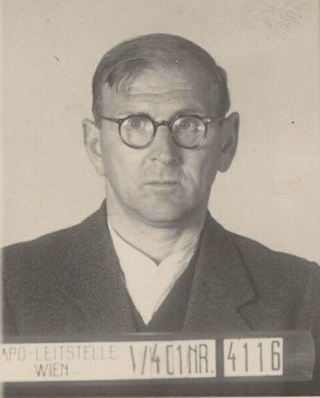
Friedrich Karas was born in Vienna, the son of a Social Democratic teacher. After elementary school, he attended the Hegelgasse Gymnasium in Vienna’s 1st district and graduated in 1913. He enrolled at the University of International Trade [Note: today the Vienna University of Economics and Business], but had to interrupt his studies just one year later, especially since he was drafted into World War I right at the start of the war. After returning home as a second lieutenant in 1918, he resumed his studies and graduated in 1921. He then worked for 12 years as a correspondent for various companies. Afterward, he felt a calling, enrolled in theology, and entered the seminary.
As a seminarian and theology student, Friedrich Karas witnessed the demise of a free and independent Austria with the invasion of the German Wehrmacht. While some seminarians began using the “Hitler salute” after the invasion, Friedrich Karas resolutely refused to do so out of a deeply felt opposition to National Socialism. On July 9, 1939, he was finally ordained a priest and, effective September 1, 1939, was assigned as a curate to the parish of Gaubitsch in the northern Weinviertel region. Half a year later, he became the parish administrator and local provisor there.
Friedrich Karas remained steadfast in his opposition to National Socialism and provoked the local Nazis with his sermons and conversations. On June 9, 1940, he was finally taken into pretrial detention by the Gestapo. The parish chronicle notes that this occurred “because of statements he had made”; officially, he was arrested for “moral offenses,” a charge frequently leveled against priests at that time. In court, this charge did not hold up, and Friedrich Karas was given a three-month suspended sentence. However, he was forced to be transferred by Gaubitsch.
On November 1, 1940, he began his service as a curate in Petronell; however, this also met with resistance from local Nazis, whereupon he became parish rector and “Expositus” at the Carmelite Church in Mayerling on May 1, 1941. Since Mayerling was a particularly small town at the time, there was no protective Catholic community, and so Friedrich Karas was arrested again on June 30, 1941. The Gestapo did not specify a precise reason for this.

Unfortunately, we do not know the specific reason for Karas’s arrest. The Gestapo cited moral transgressions, but that was merely a pretext.
On August 1, 1941, Friedrich Karas was finally deported to the Dachau concentration camp. Due to the conditions of his imprisonment, his chronic rheumatism worsened, which is why he was added to a list of disabled prisoners at the end of 1941. On March 25, 1942, he learns that he has been assigned to the next transport of disabled prisoners (Action 14f13). He then goes to Father Leopold Arthofer and asks him for the sacrament of penance.
Please be so kind as to hear my confession! I have been assigned to the next transport for the disabled and am now saying goodbye to life. I am ready. I place everything trustingly in God’s hands. Thank you. Pray for me and don’t forget me!
On March 26, 1942, Friedrich Karas was taken to the Schloss Hartheim nursing home, where the Nazis were carrying out their euthanasia program. Two days later, on March 28, 1942, Friedrich Jakob was gassed by the Nazis.
Two months later, Friedrich Karas’s urn arrived in Vienna. When his elderly father received the urn, he suffered a stroke and died. He was buried in the same grave two days before his son.

Places
Place of activity:
Persecution:
Citations
- Dokumentationsarchiv des österreichischen Widerstands (DÖW)
- Mikrut, Jan (1999): Blutzeugen des Glaubens. Martyrologium des 20. Jahrhunderts (Wien), p. 141–147.