Kuno Franz Josef Hoynigg

Personalia
Born:
Died:
Profession:
KZ Number:
Memberships
Curriculum Vitae
Kuno Franz Josef Hoynigg was born in Vienna as the legitimate son of the accountant Franz Josef Hoynigg and his wife Lona, née Gaß. After elementary school, he attended the Stiftsgymnasium Kremsmünster, where he graduated in 1912. He then enrolled in law at the University of Vienna, but dropped out and enrolled at the Exportakadmie [today: Vienna University of Economics and Business]. With the outbreak of the First World War, he was drafted and broke off his studies.
With the defeat of Austria-Hungary, the break-up of the Dual Monarchy and the expulsion of the House of Habsburg in 1918, Kuno Hoynigg returned as a first lieutenant. In 1921, he put together the 'Legion Austria', a group ready to defend Burgenland, which had just become part of Austria, in the event of Hungarian intervention. In 1922, he married Edith Winkelmann and became the father of two daughters and a son.
In the 1920s and 1930s, Kuno Hoynigg worked as a commercial clerk in the press office of the Chamber of Active Employees and was involved in the legitimist Reichsbund der Österreicher and the Eisernen Ring at Oberst a.D. Wilhelm Freiherr von Reichlin-Meldegg. When Kuno Hoynigg was president of the Association of Retired Officers of Bukovina, he fell out with the legitimist organizations because he was accused of embezzlement. As a legitimist, he is a strict opponent of National Socialism.
On March 12, 1938, Kuno Hoynigg witnesses the demise of free and independent Austria with the invasion of the German Wehrmacht. He is taken on by the Chamber of Commerce of the Ostmark and is responsible for acquiring new subscribers for the magazine 'Wirtschaft der Ostmark'. Through the field service, he comes into contact with many different people and manages to build up a small resistance cell of business people. However, this does not appear to have been particularly active.
On January 27, 1944, Kuno Hoynigg was on a trip to Bischofshofen in Salzburg. In a store, he publicly criticized the National Socialist regime. Unfortunately, exactly what he said has not been preserved. Kuno Hoynigg was denounced and arrested by the gendarmerie on the same day. The next day, he was transferred to the Gestapo in Salzburg and deported from there to the Dachau concentration camp without a trial on September 2, 1944.
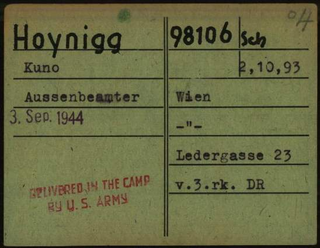
Kuno Hoynigg is liberated by the 7th US Army in the concentration camp on April 29, 1945 and returns to Vienna, which has since been liberated. He joins the newly founded Austrian People's Party (ÖVP) and the ÖVP-Kameradschaft der politisch Verfolgten und Bekenner für Österreich. He returned to work at the Chamber of Commerce, Trade, Industry, Money and Credit of Vienna and Lower Austria [today: Vienna Chamber of Commerce].
Citations
Wiener Stadt- und Landesarchiv (WStLA)
Dokumentationsarchiv des österreichischen Widerstands (DÖW)
Stenographisches Protokoll der 58. Sitzung des Nationalrates der Republik Österreich, Freitag, 14. Oktober 1921
Arolsen Archives
Matricula Online
Friedhöfe Wien - Verstorbenensuche