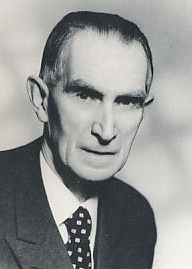
Universitätsprofessor Dr.Dr.hc. Walter Adolf Franz Heinrich
Personalia
Born:
Died:
Profession:
KZ Number:
Memberships
Curriculum Vitae
Walter Adolf Franz Heinrich was born in Haid in Bohemia [today: Bor in the Czech Republic] as the legitimate son of Franz Heinrich, a secondary school teacher, and his wife Berta, a glass refiner's daughter, née Fluch. After elementary school, he attended grammar school in Böhmisch-Leipa [today: Česká Lípa in the Czech Republic], where he graduated in 1921. From around 1921, he was active in the 'Sudeten German Boys' Association', where he soon assumed a leading position. In 1921, he met the Austrian national economist, sociologist and philosopher Othmar Spann. With his corporative state doctrine of universalism, Spann is considered one of the pioneers of the Austrian corporative state and thus the chancellor dictatorship in Austria between 1934 and 1938.
After completing his A-levels, Walter Heinrich enrolled in political science at the German University in Prague, where he graduated in 1925. In the same year, he moved to Vienna, continued his studies at the University of Vienna and was awarded a doctorate in political science. In 1926, he became a research assistant at the Institute for Political Economy and Social Theory at the University of Vienna under Othmar Spann, whose closest confidant he became from then on.
In 1928, Walter Heinrich habilitated in economics at the University of Vienna. He also established close links with the Austrian Heimatschutz. Between
1929 and 1930, he was General Secretary of the Federal Leadership of the Heimwehr and author of the undemocratic Korneuburg Oath of 18 May 1930.
After his withdrawal from the Heimatschutz in 1930, Walter Heinrich was primarily active in the so-called Sudetenland, where a Spann Group was founded in 1930. In 1933, he became an associate professor of economics at the Vienna University of World Trade [today: Vienna University of Economics and Business].
In the beginning,
in 1934, he was the driving force behind the founding of the Institute for the Estates in Düsseldorf / North Rhine-Westphalia, where he also worked as a lecturer from 1934 to 1936.
Back in May 1936, Heinrich Himmler's intelligence service, the security service of the Reichsführer SS, produced a memorandum entitled 'The Tension Circle, Dangers and Effects', in which the Tension Circle was accused of 'influencing Sudeten Germans in the sense of Roman universalism and alienating them from National Socialist Germany'.
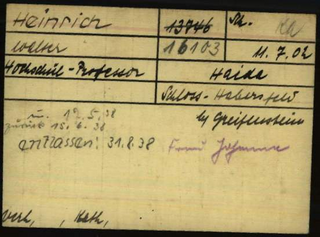
On March 12, 1938, Walter Heinrich witnessed the demise of free and independent Austria with the invasion of the German Wehrmacht. He was arrested by the Gestapo on March 16, 1938 and deported to the Dachau concentration camp on June 15, 1938. He was dismissed as a professor on March 31, 1938. He was released from prison on August 31, 1938, after which he returned to Vienna. He was arrested again on April 8, 1939 and was released on January 8, 1940. He then found work as an executive board secretary and authorized signatory of the Viennese industrial group 'Stölzle Glasindustrie A.G.' and 'Glashüttenwerke vorm. J. Schreibers Hessen A.G.' in Vienna.
In April and May 1945, Walter Heinrich witnessed the liberation of Austria and the re-establishment of the Republic. On April 27, 1945, he was rehabilitated as a private lecturer and lecturer in economics at the University of Vienna and the University of World Trade. He joins the newly founded Austrian People's Party (ÖVP) and the ÖVP-Kameradschaft der politisch Verfolgten und Bekenner für Österreich. In 1948 he became an associate professor and was appointed full professor in 1949. In 1951, he founded the 'Institute for Industrial Research', which he headed up as well as the 'Institute for Integration Issues and Economic Policy' at the University of World Trade. In 1951, he joined the 'Future' lodge of the Grand Lodge of Austria of Ancient, Free and Accepted Masons.
Walter Heinrich was one of the co-founders of the 'Austrian Economic Society' and the 'Society for Holistic Research'. In 1962, he became a corresponding member of the 'Austrian Academy of Sciences' (philosophical-historical class).
Walter Heinrich retired in 1972 and died in Graz at the age of 81.
Places
Residence:
Persecution:
Citations
Wiener Stadt- und Landesarchiv (WStLA)
Universität Graz unter www.agso.uni-graz.at/archive/webarchiv/agsoe02/bestand/15_agsoe/15bio.htm
Wikipedia unter www.de.wikipedia.org/wiki/Walter_Heinrich_(Ökonom)
Pichler, Hanns J. (1982):Im Prisma des Geistes. Besprechungsaufsätze und ausgewählte Einzelrezensionen über sechs Jahrzehnte von Walter Heinrich. Eine Festausgabe aus Anlass seines 80. Geburtstages (Graz)
Klausinger, Hansjörg (2015): Die Volkswirtschaftslehre an der Hochschule für Welthandel, 1918 - 1973. Department of Economics Working Papier N. 202 (Wien)
Arolsen Archives