Seliger Engelmar (Hubert) Unzeitig CMM
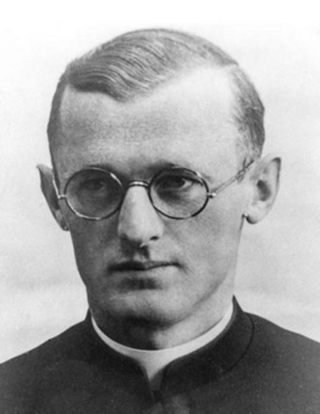
Personalia
Order Name:
Born:
Died:
Profession:
Persecution:
Imprisoned April 21, 1941 – June 3, 1941,
Dachau Concentration Camp June 3, 1941 – March 2, 1945,
Murdered on March 2, 1945
Curriculum Vitae
Hubert Unzeitig was born in Greifendorf in the Schönhengstgau region, north of Brno in Moravia, as one of six children in a farming family. His father died in 1916 while a prisoner of war in Russia, after which his mother had to raise the children on her own. Two of his sisters later joined the Mariannhill Missionary Sisters of the Precious Blood.
Due to financial hardship, Hubert Unzeitig attended only elementary school and then immediately began working in agriculture. In 1928, he finally entered the seminary of the Missionaries of Mariannhill (CMM) in Reimlingen/Nördlingen, Germany, where he graduated from high school in 1934. He then entered the novitiate of the Mariannhill Missionaries in St. Paul near Arcen in the Netherlands, where he received the religious name Engelmar. He made his first profession on May 1, 1935, and subsequently studied theology in Würzburg, where he also learned French, among other subjects. He was finally ordained a priest on August 6, 1939.
In the summer of 1940, Engelmar Unzeitig was transferred to the newly founded Mariannhiller Province in Upper Austria, near Gallneukirchen, to Riedegg Castle. At that time, about thirty French prisoners of war were already housed at Riedegg. Engelmar Unzeitig, who spoke their language, took them under his wing and celebrated Mass for them every Sunday with a sermon in French, even though this was forbidden.
Engelmar Unzeitig was a staunch opponent of National Socialism, which he considered godless and hostile to the Church. He also firmly rejected the persecution of the Jews. He made no secret of his opposition and spoke openly about his views, even at school in front of members of the Hitler Youth and during his sermons.
His public statements—that Christ, unlike Adolf Hitler, was entitled to rule over everything, including earthly matters—and his repeated criticism of the persecution of the Jews ultimately led to a complaint being filed with the Gestapo.
On April 21, 1941, Engelmar Unzeitig was arrested by the Gestapo and taken to the Linz police prison. On June 3, 1941, he was transferred to the Dachau concentration camp for violating the Malicious Practices Act. Even in this bleak environment, he served as a chaplain and was even able to convert an SS-Unterscharführer and a Russian prisoner to the Catholic faith.
When an epidemic of typhus struck the Dachau concentration camp in December 1944, Engelmar Unzeitig volunteered to serve as a nurse in the infirmary barracks.
In the final weeks of December 1944, the situation in Dachau grew increasingly dire: within a few weeks, a typhus epidemic had swept through the entire camp. Death raged mercilessly. Those stricken with typhus were crammed together in specific barracks because the infirmary could no longer accommodate them. Defenseless against their illness, the sick died like flies; camp statistics show a daily average of more than one hundred deaths. A barracks that had housed 1,600 men was left with only 400 after just a few weeks. The conditions in the barracks were appalling. The sick lay in their own excrement, delirious; they moaned, screamed, descended into madness, and thrashed about in fits. They were covered from head to toe with lice (the disease carriers!) and fleas and lay on bare wooden planks.
Because of the immediate danger of death, hardly anyone was willing to take on a nursing post in the contaminated barracks.
In this situation, the camp administration turned to the clergy. Twenty priests volunteered to help—ten Germans and ten Poles.
Father Engelmar Unzeitig was one of these 20 Catholic clergymen. They were welcomed in the “blocks of misery” as messengers from heaven.
He devoted all his free time to his poor comrades from various nations. He gave them much more than just his time and selfless effort: he gave them all his priestly love. That was his goal, even as death reaped its terrible harvest.
He devoted all his free time to his poor comrades from various nations. He gave them much more than just his time and selfless effort: he gave them all his priestly love. That was his goal, even as death reaped its terrible harvest.
In February 1945, Engelmar Unzeitig himself fell ill with typhus and died just one day after his 34th birthday, on March 2, 1945, at 7:20 a.m. The death certificate bears the inscription “Died” and lists the cause of death as typhus exanthem.
His ashes were first interred in Dachau and then reinterred in 1968 at the Herz-Jesu Church in Würzburg.
On September 24, 2016, Engelmar Unzeitig was beatified in Würzburg.
Citations
- Mikrut, Jan (2000): Blutzeugen des Glaubens. Martyrologium des 20. Jahrhunderts. Band 2 (Wien), p. 263–270.
