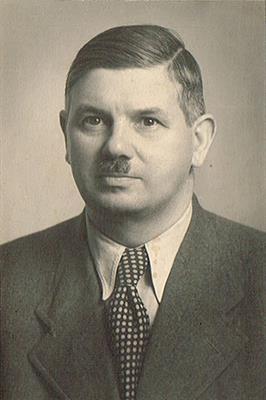
Dr. Franz Seywald
Personalia
Born:
Died:
Profession:
Persecution:
Released in 1938,
Imprisoned March 21, 1944 – July 24, 1944,
Murdered on July 24, 1944
Memberships
Curriculum Vitae
Franz Seywald attended the Humanistic Gymnasium in Salzburg. There, in 1907, he was accepted into the Almgau Salzburg secondary school fraternity. He graduated in 1910 alongside Franz Rehrl, who would later become the governor of Salzburg. Both subsequently enrolled in the Faculty of Law at the University of Vienna and became active members of the Austria Wien student fraternity in 1910.
Since he had contracted a serious illness during his physical examination for the Imperial and Royal Infantry Regiment No. 59 “Archduke Rainer,” he was discharged as unfit for service. After World War I, he entered the service of the Salzburg provincial government in 1919 and was appointed district administrator of St. Johann im Pongau in 1931. Beginning in 1933, he was also active in the VF.
After the Anschluss, he was discharged from service with reduced pension benefits. He found employment with his fraternity brother, the Salzburg notary Hans Seethaler. Beginning in 1941, Franz Seywald regularly listened to foreign radio stations such as the BBC and Seromünster (Switzerland) in his own apartment or that of Karl Biack, together with other like-minded individuals such as Maximilian Platter and Albert Schmidinger—an act that was considered a most serious crime at the time. Following a denunciation by a paid Gestapo informant [an art history student], Franz Seywald, his wife Margarethe, and their 17-year-old son Gottfried were arrested by the Gestapo on March 21, 1944, and detained in the police jail at Georg-von-Schönerer-Platz (Rudolfsplatz), where they were charged with “preparation for high treason.” Over the next few days, the other like-minded individuals were added to the group. Based on the court-issued arrest warrant of April 13, 1944, eleven of the twelve defendants were held in pretrial detention at the Regional Court’s detention center at Schanztgasse 1. His wife, Margarethe, had been released.
On April 2, 1944, the NSDAP organ *Salzburger Zeitung* ran the headline “Radio Criminals Arrested. Enemy Broadcasts Continuously Intercepted.” This was followed [as a deterrent] by the “pillory list” containing the names of all the defendants, beginning with Franz Seywald. Based on the motion filed by Chief Reich Prosecutor Ernst Lautz (1887–1979) dated June 17, 1944, the criminal trial took place before the Higher Regional Court (VGH), presided over by Roland Freisler (1893–1945), in the jury courtroom of the courthouse on Georg-von-Schönerer-Platz in Salzburg on July 21–22, 1944, immediately following the assassination attempt on Adolf Hitler. The defendants are charged with “preparation for high treason,” “aiding the enemy” pursuant to Sections 80, 83, and 91b of the RStGB, and “undermining military morale” pursuant to Section 5 of the KSSVO. The indictment filed by the Chief Imperial Prosecutor at the VGH states, among other things:
“He [Seywald] joined the Catholic CV fraternity ‘Austria Wien’ in 1920 and the VF in 1933. As district administrator of Markt Pangau under the Dollfuß–Schuschnigg regime, he was particularly loyal to the system and fought National Socialism and its supporters in a fanatical and vitriolic manner. For this, he was one of the first district administrators to receive the Silver Medal of Honor of the Republic of Austria.”
Karl Biack and Franz Seywald were sentenced to death by Freisler on July 22, 1944. The reasoning behind the verdict states, among other things:
“Franz Seywald … intercepted enemy radio transmissions approximately 150 times from the third to the fifth year of the war in his apartment in Salzburg, both alone and with acquaintances. … Together with those listening in, he subsequently made defeatist, demoralizing speeches; he even let his teenage son listen in and gave a fellow citizen a Habsburg-separatist leaflet to read, which called for desertion and demanded an ‘alliance’ with our enemies on the condition that we disarm ourselves [refers to a pamphlet that Seywald received in the mail at Christmas 1943]. Karl Biack was part of Seywald’s listening group. … Both have thus severely undermined our trust and our strength to fight valiantly for our freedom, thereby making themselves agents of subversion for our enemies in the war. They are forever disgraced and shall be punished by death.”
Franz Seywald died on July 24, 1944, in the Salzburg detention center by hanging as a result of an alleged suicide. The official letter from the Reich Governor’s Office to the Reich Ministry of the Interior dated August 7, 1944, states, among other things: “Seywald hanged himself shortly thereafter [after his conviction] while in custody.” This account of his death—“suicide by hanging”—has been passed down to this day. Another—and likely more accurate—account of Franz Seywald’s death is recounted by his grandson, Thomas Seywald, from the perspective of his father, Gottfried, the eldest son of Franz Seywald, who had also been imprisoned at the age of 18:
“My father told me… From the night of July 23 to July 24, 1944, the light in one of the cells burned all night, and everyone knew that when the light was on, the prisoner was a death row inmate. But he didn’t know which cell his father was in, so he fell asleep. Early in the morning, two of them came to get him and forced him to watch as they hanged his father, accompanied by the words: ‘Look here—that’s how we deal with traitors.’ … One of the Nazis is said to have added: ‘One less of those pigs.’ The prison chaplain himself also said at the time that they had killed him.”
Accordingly, Franz Seywald fell victim to an act of arbitrary violence by fanatical prison guards at the Salzburg remand prison. The “official” suicide story is intended to cover up these facts to this day.
Franz Seywald’s body was handed over to the Gestapo, cremated, and buried anonymously after the Salzburg Reich Governor, Gustav Adolf Scheel (1907–1979), opposed its release in order to prevent any honoring of victims of terror and any commemoration by their loved ones.
Citations
Krause, Peter/Reinelt, Herbert/Schmitt, Helmut (2020): Farbe tragen, Farbe bekennen. Katholische Korporierte in Widerstand und Verfolgung. Teil 2. Kuhl, Manfred (ÖVfStG, Wien) S. 320-322.
Photo: Biolex des ÖCV unter www.oecv.at/biolex; Stand: 14.10.2022.