Hans Spitzer
Personalia
Born:
Died:
Profession:
Persecution:
hid Jews during the war and saved them from deportation and murder
Memberships
Curriculum Vitae
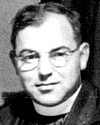
Hans Spitzer graduated from high school and the boys’ seminary in Hollabrunn and, after receiving his high school diploma, began studying theology in Vienna. On August 11, 1920, he founded the Herulia Wolkersdorf secondary school fraternity. At the beginning of the 1920–21 winter semester, he became a member of the Kürnberg Vienna student fraternity. In 1924, he was ordained a priest and subsequently served first as an assistant pastor in Groß-Engersdorf, Unteraspang, and Ernstbrunn, and then, beginning in March 1929, as a curate in Vienna-Lainz. There, he assisted the increasingly ailing parish priest Anton Schrefel (1882–1945) and gradually had to take over the management of parish affairs. Beginning in September 1930, Hans Spitzer also taught religious education at the Steinlechnergasse secondary school. In the meantime, he helped his parents with their farm in Hautzendorf.
Here, after the Third Reich’s occupation of Austria, Hans Spitzer witnessed the expulsion of the Jewish Edelhofer family, whom he knew personally. The onset of massive persecution of Jews compelled him to take action. His open rejection of National Socialism was documented by the local Nazi group in Hautzendorf in an assessment dated December 23, 1941, in the Gau file.
Hans Spitzer was, at the time, chairman of the Catholic Youth Association, which held a strictly patriotic stance during the System era [the era of the Ständestaat]. Spitzer, who already had no sympathy for National Socialism during the System era, has not significantly changed his views on this matter even now.
The mayor openly threatened to “cut Hans Spitzer’s head off” because of his support for the Jews. Hans Spitzer is said to have responded by holding out a vineyard knife to him: “Yes, go ahead and do it right now!”
With the start of mass deportations to the extermination camps in the East in 1941, Hans Spitzer—with the support of his relatives at home as well as like-minded business owners in Lainz, several parishioners, and his fraternity brothers, hid and cared for Jewish fellow citizens in the Lainz rectory “in a room concealed behind a cupboard,” according to the testimony of his aunt and housekeeper, Theresia Gotthard (d. 1970). There was certainly another hiding place as well, and the number of those saved—estimated at “around twenty,” according to Ms. Gotthard—must be considered too low. In addition to various parishioners in the know—who, among other things, procured forged exit documents as well as sufficient food supplies—his most important collaborator in these efforts was his fraternity brother Dr. med. Friedrich Schweitzer, who had lost his position as a physician at the Lainz hospital following the Anschluss. Although Hans Spitzer’s pro-Jewish stance is well known and he is under surveillance by the Gestapo, no incriminating evidence can be found against him that would have led to his conviction. Thus, the Jews he hid are also spared from being exposed and deported to concentration camps. Most of the rescue operations likely took place between 1942 and 1944. Because secrecy prevailed in these matters and no records were kept for security reasons, reliable data is lacking.
Yet the example of Spitzer and the women and men who helped him shows that there were more “righteous” people than have become known or can even be historically identified today.
On January 14, 1945, a sudden heart attack brought his tireless and selfless work to an abrupt end. Cardinal Theodor Innitzer also attended the requiem Mass at the Lainz parish church. The commemorative plaque unveiled in May 2008 at the old Lainz rectory in Vienna-Hietzing serves as a testament to the fact that Hans Spitzer’s courageous actions have not been entirely forgotten.
Old Rectory – In this house, Curate Hans Spitzer (1901–1945), with the support of parishioners, hid Jewish citizens during their persecution by the Nazi regime, thereby saving their lives.
Places
Place of activity:
Honoring:
Citations
- Krause, Peter/Reinelt, Herbert/Schmitt, Helmut (2020): Farbe tragen, Farbe bekennen. Katholische Korporierte in Widerstand und Verfolgung. Teil 2. Kuhl, Manfred (ÖVfStG, Wien), p. 328/329.