Dr. Ottokar Anton Franz (Otakar) Flanderka
Personalia
Born:
Died:
Profession:
KZ Number:
Curriculum Vitae
Otto Anton Franz Flanderka was born in Reichenau an der Knieschna in Bohemia [today: Rychnov nad Kněžnou in the Czech Republic] as the legitimate son of the lawyer Friedrich Flanderka and his wife Maria, née Haudek. After elementary school, he attended grammar school in Reichenau an der Knieschna, where he graduated in 1913.
He then moved to Vienna and studied law for a semester at the University of Vienna before being drafted into the First World War and disarming as a first lieutenant in the artillery in 1918.
After the defeat of Austria-Hungary, the collapse of the dual monarchy and the expulsion of the House of Habsburg, he moved to Paris, where he continued his legal studies at the University of Sorbonne.
Ottokar Flanderka retained his Czech citizenship and worked in Paris as a legal representative for the Austrian Fabriken Fez AG. In 1926, he publishes the legal book 'Le contrôle de la constitutionnalité des lois en Tchécoslovaquie'. This work is considered an important contemporary testimony to the functioning of early Czechoslovak constitutional jurisdiction.
Ottokar Flanderka becomes a member of the International Chamber of Commerce, economic attaché and consul general of the Czechoslovak legation and its legal representative in Paris and president of the Czechoslovak colony in Paris.
Ottokar Flanderka was a staunch opponent of National Socialism and, after the occupation of Austria and later Czechoslovakia, helped French and Jewish people to flee from the Nazis and helped to transfer their assets to the United States of America.
After the occupation of 'Rest Czechoslovakia' on March 15, 1939, he became a French citizen on April 17, 1939.
I can affirm on oath that he was held as a political prisoner and that as a human being and comrade he never and nowhere violated the ethos of a political prisoner. Even more: Otakar Flanderka, a European and democratic personality, was one of the best people I ever had the opportunity to get to know and appreciate. My regret is all the more painful and sincere that he was sacrificed in the spring of 1945, just before the liberation.
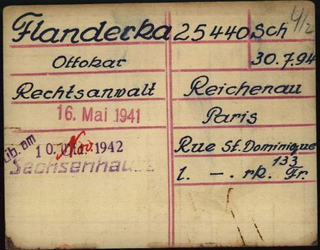
After the occupation of 'Rest Czechoslovakia' on March 15, 1939, he became a French citizen on April 17, 1939. After the capitulation of France on June 22, 1940, Ottokar Flanderka was arrested by the Gestapo in Paris on July 30, 1940 for "facilitating escape and concealment of assets" and taken into custody in Paris, Brussels, Berlin and Prague.
On May 16, 1941, Ottokar Flanderka was deported to the Dachau concentration camp and transferred from there to the Sachsenhausen concentration camp on November 10, 1942. On November 20, 1942, the investigations against him by the Chief Reich Prosecutor at the People's Court were officially closed. However, this does not change his imprisonment in the concentration camp.
In the Sachsenhausen concentration camp, he is ill for a longer period before working as a scribe in the infirmary and then in the Berlin-Licherfelde satellite camp and the Heinkel branch camp, as a scribe and interpreter for Czech and French.
In early March 1945, Ottokar Flanderka was transferred to the Bergen-Belsen concentration camp under the impression of the approaching Red Army.
Ottokar Flanderka died in the Bergen-Belsen concentration camp on April 24, 1945. A cenotaph was later erected for him at the cemetery in Prague 3.
His sister, Maria Bracher, who lived in Vienna, joined the newly founded Austrian People's Party after the liberation of Austria and the re-establishment of the Republic in April and May 1945. After the liberation of Austria and the re-establishment of the Republic in April and May 1945, his sister, Maria Bracher, who lived in Vienna, joined the newly founded Austrian People's Party (ÖVP) and the ÖVP-Kameradschaft der politisch Verfolgten und Bekenner für Österreich.
Places
Residence:
Persecution:
Death Place:
Citations
Wiener Stadt- und Landesarchiv (WStLA)
Archiv der Universität Wien
Archiv ÖVP-Kameradschaft der politisch Verfolgten und Bekenner für Österreich
Arosen Archives
www.myheritage.com
www.vets.cz/vpm/49089-kenotaf-otakar-flanderka/