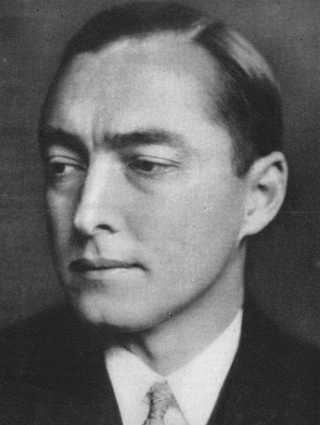
Richard Nikolaus (Eijirō Aoyama) Graf von Coudenhove-Kalergi
Personalia
Born:
Died:
Profession:
Memberships
Curriculum Vitae
Richard Nikolaus Count von Coudenhove-Kalergi was born in Tokyo as the legitimate son of the Austrian Imperial and Royal Count Heinrich von Coudenhove-Kalergi, Austrian Imperial and Royal Chargé d'Affaires in Japan, and his wife Mitsuko, née Aoyama. In Japan, he is therefore also known as Eijirō Aoyama. On his father's side, the Brabant Coudenhoves had received the noble title for their participation in the Crusade of 1099 and could look back seamlessly to their ancestor Gerolf, who died on March 3, 1259. The name Kalergi goes back to a Byzantine Cretan noble family, which appears in the sources as both Kalergis and Kalergi. The form Kalergis corresponds to the older Greek spelling Καλεργής. In the western, mainly Venetian tradition, the Latinized variants Calergi and Calergis can also be found.
When Richard Count von Coudenhove-Kalergi was one year old, the family moved to his parents' Ronsperg Castle in Bohemia. He was initially taught by private tutors and then transferred to the Theresianum in Vienna, where he graduated in 1913. In the same year, he enrolled in philosophy at the University of Vienna. In 1915, he married the Jewish actress Ida Klausner (stage name Ida Roland) and was awarded a doctorate in philosophy in 1916.
In 1922, Richard Count von Coudenhove-Kalergi developed the idea of a 'Pan-Europe' - a common United Europe - as a lesson from the catastrophe of the 20th century, the First World War. In the same year, he joins the masonic lodge 'Humanitas' of the Grand Lodge of Austria [today: Grand Lodge of Austria of Ancient, Free and Accepted Masons].
In 1923, Richard Count von Coudenhove-Kalergi writes his programmatic book 'Pan-Europa' at Würting Castle in Upper Austria. In 1924, he founded the Pan-European Union, the oldest European unification movement. Over time, Albert Einstein, Thomas Mann and Otto von Habsburg became members, as did leading politicians such as Konrad Adenauer, the French Foreign Minister and Nobel Peace Prize winner Aristide Briand, the Czechoslovak Foreign Minister Edvard Beneš and the French Prime Minister Edouard Herriot. The Austrian section was led by the then Federal Chancellor Karl Renner and his deputy Ignaz Seipel. Richard Count von Coudenhove-Kalergi is thus the mastermind behind today's European idea and the European self-image and identity. The principles of a Europe in the sense of Coudenhove-Kalergi are freedom, peace, prosperity and culture, which still characterize Europe's self-image today.
In the 1930s, Richard Count von Coudenhove-Kalergi spoke out energetically in various publications against the National Socialist hatred of Jews in the German Reich and National Socialism as such. He thus continued the work of his father, whose study on the essence of anti-Semitism he republished. In the National Socialist German Reich, the Paneuropa Union, as a representative of an ideological counter-thesis, is strictly forbidden.
When we arrived in Vienna at the beginning of March, the city was hardly recognizable. Hitler's threats against Schuschnigg had triggered a wave of patriotism. The enmity between the Social Democrats and the Christian Socials seemed forgotten. Vienna's working class was ready to join the fight for Austrian independence under Schuschnigg's leadership.
Boosted by this patriotic tide, Schuschnigg announced a plebiscite on the question of Austrian independence for Sunday, March 13. He was convinced that seventy to eighty percent of Austrians would vote against annexation to the Third Reich.
On the evening of March 11, 1938, Richard Count von Coudenhove-Kalergi and his wife received the news that Chancellor Kurt von Schuschnigg was resigning under pressure from the German Reich, its overwhelming military superiority and the knowledge that no other country would stand by Austria in order to prevent bloodshed and save lives, the Austrian patriotic mood was tipped.
Richard Count von Coudenhove-Kalergi and his wife had guests at home at this time. They immediately bid their guests farewell and drive to the Swiss embassy. Although the ambassador there invites them to spend the night, they decide to flee that very night. After traveling in a Swiss diplomatic car, they are spared by the Nazi hordes.
With a pistol in their hands, then
Our central office in the Hofburg was immediately occupied: Nazi Chancellor Seyß-lnquart had set up his residence there. Forty thousand volumes of the Paneuropa publishing house were destroyed, as were all our archives and correspondence since the beginning of the movement. Our apartment was searched and sealed by the Gestapo. Austria's name was erased from the map. Hitler's position in Germany and in Europe seemed unshakeable.
In 1947, Count Richard von Coudenhove-Kalergi founded the European Parliamentary Union (EPU), which was to bring together the parliamentarians of the individual European parliaments in a European assembly. The EPU initially asserts its independence in the face of merger proposals from other organizations seeking to unite Europe. It was not until 1952 that it joined the European Movement. Richard Count von Coudenhove-Kalergi becomes Honorary President of this movement. After the death of his first wife, he marries the Swiss Alexandra Countess von Tiele, née Bally.
On May 18, 1950, Richard Count von Coudenhove-Kalergi is the first person to receive the International Charlemagne Prize of the City of Aachen 'in recognition of his life's work for a united Europe'.
.

Shortly afterwards, he submitted a draft for a European flag to the Council of Europe, but the use of the Christian symbol of the cross meant that there was no consensus. In 1955, he proposed the 'Ode to Joy', Beethoven's setting of Schiller's poem 'An die Freude', as the European anthem. The melody has been the anthem of the Council of Europe since 1972 and the anthem of the European Union since 1985.
Places
Residence:
Honoring:
Citations
Wikipedia unter de.wikipedia.org/wiki/Richard_Coudenhove-Kalergi
Archiv Paneuropa-Bewegung Österreich
www.myheritage.com