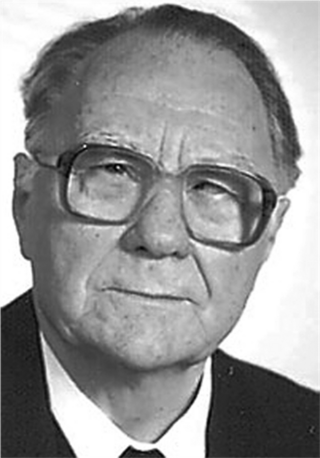
Karl Strobl
Personalia
Born:
Died:
Profession:
Persecution:
Imprisonment July 8, 1938 – August 10, 1938,
Imprisonment October 21, 1940 – January 1, 1942,
Penal company starting January 1, 1942
Honors:
Silver Medal of Honor from the State of Lower Austria
Ring of Honor from the Market Town of Ulrichskirchen-Schleinbach
Memberships
Curriculum Vitae
Karl Strobl was born in Vienna as the legitimate son of Friedrich Strobl and Emilie, née Harmer. After elementary school, he attended the gymnasium in Vienna-Hernals. In addition, he was a leader in the Catholic Youth group at St. Bartholomew’s Parish on Kalvarienberg and in the Austrian Youth Movement (ÖJV), the youth organization of the Fatherland Front, in Vienna’s 17th district.
On March 12, 1938, the devout Catholic and patriotic Austrian witnessed the downfall of a free and independent Austria with the invasion of the German Wehrmacht. Immediately after the occupation of Austria, he led the Calvarienberg Group—an underground organization that had emerged from the Catholic Youth—which, through Alfred Kostelecky, came into contact with the Eisen Group and was active in distributing leaflets, graffiti, and acts of sabotage. Above all, they distributed the sermons of the Bishop of Münster, Clemens August Graf von Galen. In early July 1938, the Eisen Group was exposed, and with it, Karl Strobl. From July 8, 1938, to August 10, 1938, he was imprisoned for the first time and expelled from middle school on May 31, 1939. To better conceal their activities, the boys of the Calvarienberg Group joined the German Red Cross.
In the spring of 1940, Karl Strobl made contact with the Haan Group, led by resistance fighter Otto Haan. The Haan Group saw itself as continuing the tradition of the Austrian Youth Movement (ÖJV) and sought to restore a free and independent Austria.
I swear by God that I work for the Austrian Youth Movement, that I will support the Austrian Youth Movement by all means necessary, and that I will not betray its existence.
Karl Stobl pays his membership dues and attends the evening meetings, which follow a training plan developed by Otto Haan and also include military training. The meetings take place at the City Driving School, located at Porzellangasse 2 in Vienna’s 9th district, which is Otto Haan’s workplace.
On October 15, 1940, the resistance group was uncovered by the Gestapo. As a result, Karl Strobl was arrested again on October 21, 1940, and held until November 18, 1941. On November 19, 1941, a special court sentenced him to six months in prison for membership in a secret society, and on January 1, 1942, he was sent to the Arctic front as a marine for “probation.”
An officer who meant well by me tried to assign me as a medic. But when they saw the “p. u.” (politically unreliable) in my personnel file, I was immediately sent to a penal company.
He was deployed as a combat swimmer against the Russian fleet in the Arctic Ocean. In such missions—to which opponents of the regime were deliberately assigned—the chances of survival were nearly zero. He survived and was taken prisoner by the Russians.
While a prisoner of war in Russia, Karl Stobl witnessed the liberation of Austria and the reestablishment of the Republic in April and May 1945, respectively. He himself was not released until 1946.
Upon returning home, Karl Strobl earned his high school diploma as an external student and subsequently studied theology in Vienna. On June 2, 1947, he joined the Rudolfina student fraternity because he had met Rudolfina members Wilfried Daim, Helmut Gnambs, and Hubert Jurasek in the resistance groups. He also became a member of the newly founded Austrian People’s Party (ÖVP) and the ÖVP Association of the Politically Persecuted and Defenders of Austria. After his ordination in 1952, he initially served as an assistant pastor (curate) in Brunn am Gebirge, Gerasdorf-Süßenbrunn, and Schwechat, and then as pastor in Schleinbach (1959–1989) in the Weinviertel region of Lower Austria. In 1972, he was additionally assigned the parish of Kronberg. In 1981, he became a member of the Herulia Wolkersdorf high school alumni association.
In 1989, he retired and spent his later years as a temporary priest in Kirchberg am Wechsel. He died there at the age of 93 and was laid to rest in the cemetery in Kirchberg am Wechsel.
Places
Place of activity:
Residence:
Citations
Krause, Peter/Reinelt, Herbert/Schmitt, Helmut (2020): Farbe tragen, Farbe bekennen. Katholische Korporierte in Widerstand und Verfolgung. Teil 2. Kuhl, Manfred (ÖVfStG, Wien) S. 350.
Landesarchiv NÖ
Diözesanarchiv Wien