Franz Josef Kittel

Personalia
Born:
Died:
Profession:
Persecution:
Imprisonment March 18, 1938 – June 16, 1938,
Dachau Concentration Camp June 16, 1938 – December 23, 1938
KZ Number:
Memberships
Curriculum Vitae
Franz Josef Kittel was born in Vienna, the legitimate son of machine operator Josef Kittel and his wife Auguste, née Kramer. He was severely nearsighted from an early age. At age 15, he leaves compulsory school, joins the Social Democratic Workers’ Party (SDAP) [today: Social Democratic Party of Austria (SPÖ)], and becomes a paid official in the youth division of the Central Association of Commercial Employees.
Following the Socialist February Uprising in February 1934 and the subsequent ban on the Social Democratic Workers’ Party (SDAP), he became involved in the peace movement led by Ernst Winter, the Catholic, legitimist deputy mayor of Vienna. Through these circles, he eventually became a member of the Reichsbund der Österreicher (Reich Federation of Austrians). There, as a staunch opponent of National Socialism, he fought against Adolf Hitler’s plans to annex independent Austria.
On March 12, 1938, the Austrian patriot witnessed the downfall of a free and independent Austria with the invasion of the German Wehrmacht. On March 18, 1938, he was arrested by the Gestapo and deported to the Dachau concentration camp on June 16, 1938. The severe physical strain endured by Josef Kittel, who was forced to perform road construction labor, led to the loss of vision in his left eye. On December 23, 1938, he was released from custody and returned to Vienna, where he was required to report regularly to the Gestapo.
After a period without work or income, he found employment at a freight forwarding company. On December 2, 1939, he married Auguste Jelinek. The marriage remained childless.
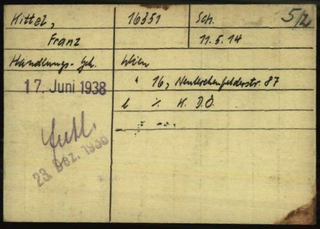
In Vienna, Franz Kittel witnessed the liberation of Austria and the reestablishment of the republic in April and May 1945, respectively. He joined the newly founded Austrian People’s Party (ÖVP), the Austrian Youth Movement (ÖJB) [today: Young Austrian People’s Party (JVP)], and the ÖVP Association of the Politically Persecuted and Defenders of Austria. In the Austrian Youth Movement (ÖJB), he was a founding member, a member of the national executive committee, and one of the first regional chairmen of the Austrian Youth Movement’s Vienna regional organization.
Never again to Anschluss! Never again to Dachau!
Professionally, Franz Kittel opened a tobacco shop and served as the national chairman of the tobacco retailers’ association until 1972. Within the ÖVP Association of the Politically Persecuted and Advocates for Austria, he served for many years as editor-in-chief of the newspaper *Der Freiheitskämpfer* and as deputy state chairman of the Vienna state organization. He also became active as an author and wrote a book titled *Nacht über Österreich* (Night Over Austria).
We must become passionate advocates for peace. Peace in the smallest unit—whether in the family, at school, or at work—is the first prerequisite for world peace. No one is perfect. I can only accept my brother in the community just as he is. If I respect his perspective and show understanding for his weaknesses, I will also gain his trust. Trust is one of the most important cornerstones of peace.
Let us set aside everything that divides us. Let us remove all obstacles that stand in the way of peaceful coexistence. This requires that we ourselves be willing to make sacrifices. Only where people relate to one another with trust and understanding will harmony reign. Where harmony reigns, peace reigns; where discord exists, there is war. And war means destruction, annihilation, ruin, and death.
We must repeatedly drive this home to our youth. We must constantly highlight the sheer horror of war and the dreadful disruption of human life caused by it.
Young people must be filled with revulsion toward war. Never again shall night fall upon Austria, sacrificing the most precious lives of our people in a new war. The past decade has made it painfully clear to us which path we must avoid in order never again to fall into the abyss of catastrophe.
Franz Kittel died unexpectedly of a heart attack at the age of 60. He was laid to rest at the cemetery in Vienna-Ottakring.
Citations
Wiener Stadt- und Landesarchiv (WStLA)
Der Freiheitskämpfer Nr. 5/65 und Nr. 1/75
Arolsen Archives
Matricula Online
Friedhöfe Wien - Verstorbenensuche
