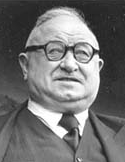
Dr. Emil Maurer (geb. Eisig Nachbar)
Personalia
Born:
Died:
Profession:
Persecution:
Imprisonment March 22, 1938 – April 2, 1938,
Dachau Concentration Camp April 2, 1938 – September 22, 1938,
Buchenwald Concentration Camp September 22, 1938 – May 24, 1939,
Emigration 1939
KZ Number:
Honors:
Grand Decoration of Honor for Services to the Republic of Austria
Gold Medal of Honor of the Federal Capital Vienna
Memberships
Curriculum Vitae
Emil Maurer was born as Eisig Nachbar in Kutti in Moravia [today Kúty in Slovakia] into very poor circumstances. Immediately after elementary school, he learned the watchmaking trade and moved to Vienna as early as 1896, at the age of 12. In 1898, he began an apprenticeship as a metal printer and, in the same year, joined the Ottakring chapter of the Social Democratic Association of Young Workers. In 1901, he completed his metal printing apprenticeship. In 1911, he earned his high school diploma and began studying law at the University of Vienna. In 1913, he changed his name to Emil Maurer.
Emil Maurer earned his doctorate in 1916 and served as an officer in World War I. After the war, he was active in the workers’ council movement. In the workers’ council of the Neubau district, he represented the left wing and advocated for cooperation between communist and social democratic forces. In 1918, as a representative of the “Gerechtigkeit” People’s Association, he was elected deputy district chairman of Neubau, a position he held for 13 years. Shortly thereafter, the People’s Association became the district organization of the Social Democratic Workers’ Party (SDAP). In 1923, he became commander of the Neubau district group in the newly founded Republican Protection League. That same year, Emil Maurer established his own law practice. Between 1932 and 1934, he served as district chairman in Vienna-Neubau. In this role, he was a driving force behind the construction of the prayer house of the Jewish Association of Neubau.
Although Emil Maurer did not directly participate in the socialist February uprisings of 1934, he was briefly interned at the Wöllersdorf detention camp under the authoritarian Ständestaat. Afterward, he returned to Vienna and worked as a lawyer.
On March 12, 1938, Emil Maurer witnessed the downfall of free and independent Austria when the German Wehrmacht marched in. On March 22, 1938, he was arrested by the Gestapo and, on April 2, 1938, deported to the Dachau concentration camp as part of the so-called “Prominententransport.” On September 22, 1938, he was transferred to the Buchenwald concentration camp. Emil Maurer was finally released from the concentration camp on May 24, 1939. Immediately afterward, he went into exile in London. In 1940, he was interned on the Isle of Man as an “enemy alien.” He became active in the “Austrian Labor Club.” In 1942, he was a member of the Delegates’ Conference of Austrian Socialists in Great Britain and was in contact with Oskar Czernetz and Oskar Pollak.
In Great Britain, Emil Maurer witnessed the liberation of Austria and the reestablishment of the Republic of Austria. In 1946, he returned to Austria and reopened a law practice. In the second elections for the executive board of the reestablished Jewish Community in 1948, he served as the lead candidate on the list of the Federation of Working Jews and became vice president of the Jewish Community.
From February 1952 to February 1963 (when he resigned from office for health reasons), Emil Maurer served as president of the Jewish Community of Vienna. His tenure included, among other things, the establishment of the Federal Association of Jewish Communities in Austria, the revival of the magazine *Die Gemeinde* as a monthly publication, the representation of Jewish interests in the Austrian legislative process (contributing to and advocating for laws and regulations) regarding compensation and “restitution,” the fight against antisemitism and neo-Nazism, the establishment of international contacts with global Jewish organizations, and the strengthening of ties with the State of Israel.
On December 22, 1967, he died after a long and serious illness. A few days later, he was buried in a grave of honor provided by the Jewish Community of Vienna at the Vienna Central Cemetery.
Places
Residence:
Persecution:
Citations
Dokumentationsarchiv des österreichischen Widerstands (DÖW)
Telephonbuch Lehrmann 1938
Wikipedia unter https://de.wikipedia.org/wiki/Emil_Maurer_(Politiker)
Geschichte Wien Wiki unter https://www.geschichtewiki.wien.gv.at/Emil_Maurer