Dr. Hans Pernter
Personalia
Born:
Died:
Profession:
Persecution:
Imprisonment March 15, 1938 – June 24, 1938,
Dachau Concentration Camp June 24, 1938 – September 27, 1939,
Flossenbürg Concentration Camp September 27, 1939 – March 2, 1940,
Dachau Concentration Camp March 2, 1940 – October 10, 1940,
Resistance fighter (undetected),
Imprisonment October 7, 1944 – April 6, 1945
KZ Number:
Memberships
Curriculum Vitae
After graduating from high school in Vienna in 1919, Hans Pernter studied physics and geography at the University of Vienna, where he earned his Dr. phil. degree in 1911. In 1905, he was admitted to the Norica fraternity. He devoted all his energy to championing the Catholic student fraternities, particularly during the period of the “academic Kulturkampf.” In 1908, he co-founded the Marco-Danubia fraternity in Vienna. He was appointed the first chairman of the “Studentenunterstützungsverein Akademikerhilfe” (Student Support Association for Academics), founded on November 21, 1921, a position he held until 1933.
After his time as a university assistant, his career initially took him to the Ministry of Labor (Central Hydrographic Office). He was then transferred to the Ministry of Education, where he began as the minister’s secretary and rose to become a member of the Minister’s Executive Committee and head of the Arts Section. From 1932 to 1934, he headed the Arts Section and was responsible for the federal theaters. In 1934, he was appointed State Secretary, and in 1936, Federal Minister of Education.
Following the Anschluss, Hans Pernter was arrested on March 15, 1938, as a member of Kurt von Schuschnigg’s last cabinet and admitted to the Dachau concentration camp on June 24, 1938; he was transferred to Flossenbürg in the fall of 1939 and returned to Dachau in the spring of 1940. He was released from there in October 1940. After his release from prison, he worked at a tax consulting firm. He assumed the chairmanship of Resistance Group 05, in which Felix Hurdes and Lois Weinberger were also active. However, when his son was killed in action in Russia in 1943, he withdrew from the group.
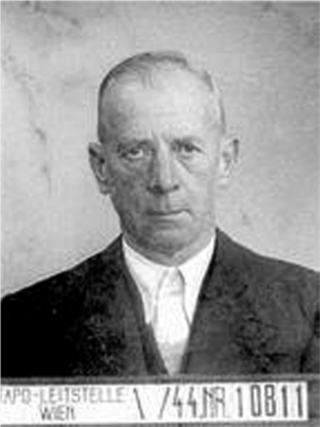
On October 7, 1944, following the failed assassination attempt on Adolf Hitler on July 20, he was arrested again and had his fingerprints taken by the Gestapo in Vienna. An illness—typhus—saved him from trial before the People's Court. He remained in pretrial detention until the liberation of Vienna by the Red Army on April 6, 1945.
After the war, he returned to politics and was one of the co-founders of the Austrian People’s Party (ÖVP) on April 17, 1945; he served as the party’s executive chairman and was a member of the National Council from 1945 to 1949. Until his death, he was head of the Arts Section at the Ministry of Education.
Places
Persecution:
Residence:
Citations
Krause, Peter/Reinelt, Herbert/Schmitt, Helmut (2020): Farbe tragen, Farbe bekennen. Katholische Korporierte in Widerstand und Verfolgung. Teil 2. Kuhl, Manfred (ÖVfStG, Wien) S. 249/250.; Photo: ÖVfStg