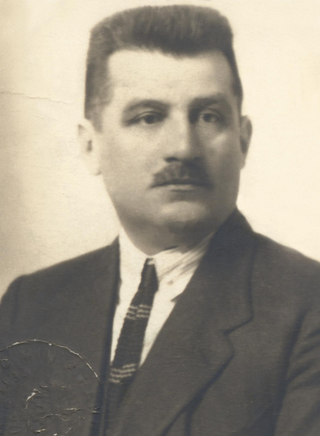
Abg.z.NR a.D. RegR Franz Binder
Personalia
Born:
Died:
Profession:
Persecution:
Imprisonment March 12, 1938 – April 23, 1938
Memberships
Curriculum Vitae
Franz Binder was born in Rechnitz, Burgenland, the legitimate son of farmer Johann Binder and Maria, née Tausz. [Note: At that time, Rechnitz was still located in western Hungary and was called Rohonc.] After attending elementary school, he completed an apprenticeship as a bricklayer and worked briefly in that trade before serving in the 13th Field Artillery Regiment in Ödenburg [today: Sopron], rising to the rank of sergeant.
Franz Binder then joined the Burggendarmerie in Vienna and subsequently became a police officer in the State Police. From 1921 to 1922, he was a member of the administrative office for the new federal state of Burgenland and was involved in establishing the Christian Social Party of Burgenland, serving on its state party executive committee from 1921 to 1934. In 1922, he was elected to the Austrian National Council. In 1929, he became an honorary member of the Austro-Peisonia fraternity. He married Susanne Gajdzica, who was originally from Silesia.
Between 1927 and 1930, he also served as regional director of the Burgenland Heimatschutz. In 1930, he demonstratively resigned from this position because he did not wish to take the so-called Korneuburg Oath.
After serving as a member of the Federal Council from December 1930 to May 1931, he returned to the National Council and remained in that position until one day after the proclamation of the Ständestaat constitution on May 1, 1934. In 1935, he became deputy commander of the Burgenland State Fire Department. Franz Binder served in the State Police until April 30, 1937, and then retired.
On March 12, 1938, this staunch Austrian and devout Catholic witnessed the downfall of free and independent Austria with the invasion of the German Wehrmacht.
On the very day of the occupation of Austria, Franz Binder was arrested by the Gestapo and remained in custody until April 23, 1938. The conditions of his detention were so poor that he contracted myocarditis, from which he would never fully recover. He died at the age of 62 from myocarditis, cardiac dilation, and pericardial effusion. He did not live to see the liberation of Austria.
After Austria’s liberation, his wife, Susanne Binder, became active in the ÖVP Association of the Politically Persecuted and Defenders of Austria. She died in Vienna in 1952.
Places
Residence:
Citations
Wiener Stadt- und Landesarchiv (WStLA)
Archiv ÖVP-Kameradschaft der politisch Verfolgten und Bekenner für Österreich (KPV)
Biolex des ÖCV
Wikipedia unter de.wikipedia.org/wiki/Franz_Binder_(Politiker,_1881)