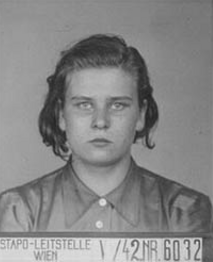
Gertrude Springer (geb. Hausner)
Personalia
Born:
Died:
Profession:
Persecution:
Imprisonment May 15, 1942 – April 29, 1945
Honors:
Decoration for Services to the Liberation of Austria
Memberships
Curriculum Vitae
Gertrude Hausner was born in Vienna as the legitimate daughter of Franz Hausner, a hat maker and metalworker, and Rosalia “Rosa,” née Beneš. The socially democratic working-class family from Ottakring had two other daughters and a son in addition to Gertrude.
After attending elementary and middle school, she completed an apprenticeship as a corset maker at the Ella Merl company. Between 1933 and 1934, she was a member of the Rote Falken in Ottakring, an organization of which Paul Springer was also a member at the time. After the Red Falcons were banned following the Socialist February Uprisings of 1934, she was a member of a hiking group affiliated with the Volksbildungsverein in Vienna from 1935 to 1936; however, this group was merely a disguised continuation of the Red Falcons.
On March 12, 1938, Gertrude Hausner witnessed the downfall of a free and independent Austria with the invasion of the German Wehrmacht. Even after the occupation of Austria by Nazi Germany, the hiking group continued to exist. In the summer of 1940, she was invited by another member of the hiking group, Elfriede Hartmann—who was active in the Communist Youth Association—to join the resistance group “Soldatenrat.” The group sought to build resistance within the German Wehrmacht.
Gertrude Hausner subsequently became a key distributor of communist literature for the resistance group. She produced and distributed the magazines *Die Rote Jugend* and *Soldatenrat*, organized envelopes, and helped prepare direct-mail pieces. In these leaflets, some of which were sent via field post, the group sought to refute Nazi war propaganda and called for an end to the war. Gertrude Hausner also arranged a hiding place for the duplicating machine when the group realized it was already under surveillance by the Gestapo.
In October 1941, she was drafted into the Reich Labor Service and, beginning in April 1942, worked as a streetcar driver in Dresden. There, following the dismantling of the resistance group by the Vienna Gestapo on May 15, 1942, she was arrested and charged with conspiracy to commit high treason and aiding the enemy. She spent her pretrial detention at the Krems detention center. On September 24, 1943, she stood trial before the 5th Senate of the People's Court alongside Anna Senhofer, Edith Gadawits, and Felix Imre. The defense was able to convince the court that the defendant had not fully grasped the full implications of her actions, and her young age at the time of the offense was also taken into account. Gertrude Hausner, like Anna Senhofer, was therefore sentenced to twelve years of penal servitude. The court, however, imposed the death penalty on Felix Imre and the nineteen-year-old Edith Gadawits; Gadawits’ sentence was later commuted to a period of penal servitude. Gertrude Hausner served her sentence at the Aichach Penal Servitude Facility in Bavaria. She formed a friendship with the architect and resistance fighter Margarethe Schütte-Lihotzky, with whom she shared a cell in the infirmary. There, on April 29, 1945, she witnessed the liberation of penal servitude by American troops and was able to return to liberated Vienna shortly thereafter.
In 1946, Gertrude Hausner married the communist and concentration camp survivor Paul Springer, who had been deported to the Dachau concentration camp on April 1, 1938, as part of the so-called “Prominententransport” and transferred from there to the Buchenwald concentration camp. Their daughter was born in 1948. Paul Springer, a full-time party official, was killed in an accident in 1949 during an election campaign trip in Burgenland.
Gertrude Springer subsequently served as an official for the Communist Party of Austria (KPÖ) and its youth organization, “Freie Österreichische Jugend,” in Ottakring, and later as a staff member for the Währing district organization and the “Federation of Democratic Women.” She then worked on the editorial staff of the magazine “Stimme der Frau” and as a staff member at the Central Committee of the Communist Party of Austria (KPÖ). After her retirement in 1980, she remained active in the party’s 23rd District organization and appeared as a contemporary witness and former resistance fighter at numerous events and discussions.
Gertrude Springer was a member of, among others, the Austrian Trade Union Federation, the Alfred Klahr Society, the Federation of Democratic Women, and the group “Frauenhetz.” She died in Vienna at the age of 92, two days before her 93rd birthday, and was laid to rest at the cemetery in Vienna-Baumgarten.
Places
Residence:
Citations
Dokumentationsarchiv des österreichischen Widerstands (DÖW)
biografiA unter www.biografia.sabiado.at/springer-gertrude/
Wien.Geschichte.Wiki unter www.geschichtewiki.wien.gv.at/Gertrude_Hausner
