Emmerich Karl Hornich

Personalia
Born:
Died:
Profession:
Persecution:
Imprisonment March 24, 1938 – June 16, 1938,
Dachau Concentration Camp June 16, 1938 – September 27, 1939,
Flossenbürg Concentration Camp September 27, 1939 – March 2, 1940,
Dachau Concentration Camp March 2, 1940 – April 29, 1945
KZ Number:
Honors:
Decoration for Services to the Liberation of Austria
Memberships
Curriculum Vitae
Emmerich Karl Hornich was born in Oberfellabrunn, Lower Austria, the legitimate son of Karl Hornich and his wife Maria, née Scheidl. After elementary school, he attended secondary school, then trained as a locksmith, and moved to Vienna.
Initially, Emmerich Hornich was sympathetic to the rising National Socialism and turned toward it. Between 1932 and 1935, he was a member of the NSDAP and was sentenced to three weeks in prison in 1933 for his National Socialist activities. In 1935, he recognized the malevolence of this ideology, broke with National Socialism, and joined the Fatherland Front and the Vienna Homeland Defense. From then on, the patriotic Austrian took a firm stand against National Socialism.
On March 12, 1938, Emmerich Hornich witnessed the downfall of a free and independent Austria with the invasion of the German Wehrmacht. On March 24, 1938, the Vienna Gestapo arrested him in Großwiesendorf for his opposition to National Socialism. He was severely mistreated during his arrest. On June 16, 1938, he was deported to the Dachau concentration camp. When, following Hitler’s Germany’s invasion of Poland on September 1, 1939, the Dachau concentration camp was temporarily cleared for the SS, he was transferred to the Flossenbürg concentration camp on September 27, 1939. From there, he was transferred back to the Dachau concentration camp on March 2, 1940.
In Dachau, Emmerich Hornich, a Catholic layperson, participated in the prisoners’ religious life. He put his craftsmanship to use for the camp chapel. On September 24, 1944, he decided to craft a metal monstrance. In doing so, he combined designs by the imprisoned priests Josef Albinger and Karl Schmidt. The inverted triangle of the “Eye of God” is also intended to serve as a reminder of the red triangles worn by political prisoners. In early 1945, Hornich began work on the project. Among the materials he procured was silver from an Austrian five-schilling coin. After his priestly advisors were released in the spring of 1945, work came to a standstill; the monstrance remained unfinished.
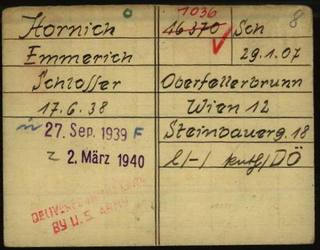
On April 29, 1945, Emmerich Hornich witnessed the liberation of the Dachau concentration camp by American troops. After more than seven years of imprisonment under the Nazis, he thus also witnessed the liberation of Austria and the restoration of the Republic. He returned to Vienna on October 10, 1945, and was unable to work for half a year. On April 21, 1946, he married Maria Anna Brandl, moved to Innsbruck, and later became the father of a son and a daughter.
Emmerich Hornich joined the newly founded Austrian People’s Party (ÖVP) and the ÖVP Association of the Politically Persecuted and Defenders of Austria. Later, he lived with his family in Innsbruck, where he opened a metalworking shop at 13 Lönsstraße.
After the war, Emmerich Hornich advocated for the interests of former victims of persecution. In 1952, he served as executive regional chairman of the Association of the Politically Persecuted and Confessors for Austria—Tyrol Regional Group. In a dispute with ÖVP National Council member Franz Josef Kranebitter, he defended the victims’ claims for compensation. In the *Tiroler Nachrichten* of February 22, 1952, under the headline “Justice with Reservations?”, he called for appropriate redress: “Justice demands full redress!”
On the initiative of Emmerich Hornich, the memorial bell was erected in front of the Chapel of Christ’s Agony. Former Austrian prisoners and the Austrian federal government financed the project. The Innsbruck-based company Graßmayr cast the bell, which weighs about three metric tons; Emmerich Hornich crafted the bell frame together with his employees. On July 22, 1961, Abbot Berthold Niedermoser of Schlierbach consecrated the bell. It is dedicated to the deceased fellow prisoners of all nations.
In 1975, Emmerich finally retired. He died at the age of 78 in Innsbruck and was laid to rest at the cemetery in Axams.

His son Clemens Hornich is also active in the ÖVP Association of the Politically Persecuted and Defenders of Austria, serving, among other roles, as regional chairman of the ÖVP Association of the Politically Persecuted and Defenders of Austria—Tyrol/Vorarlberg Regional Group.
Places
Residence:
Persecution:
Citations
Clemens Hornich, Privat
Arolsen Archives
Matricula Online
Lossin, Eike (1968): „Gott feiern im KZ“, S. 187–189; dort Hornichs Erinnerungen nach Heinz Römer, Beitrag zur „Geschichte einer Monstranz“, in: Stimmen von Dachau. S. 66–67.
Hornich, Clemens: Bericht zum Jahrestag der Befreiung des KZ Dachau am 30. April 2017, in: Der Freiheitskämpfer, Nr. 48 (2017).
Der Sozialistische Kämpfer, März–April 1952, S. 10–11. Wiedergabe der Kontroverse zwischen Franz Kranebitter und Emmerich Hornich über die Wiedergutmachung.
Katholische Seelsorge an der KZ-Gedenkstätte Dachau, „Todesangst Christi Kapelle“, Abschnitt „Die Glocke“. Angaben zur Gedächtnisglocke
