Seliger Marcel Callo
Personalia
Born:
Died:
Persecution:
Imprisonment April 19, 1944 – October 7, 1944,
Flossenbürg Concentration Camp October 7, 1944 – October 25, 1944,
Mauthausen Concentration Camp October 25, 1944 – October 26, 1944,
Gusen I Concentration Camp October 26, 1944 – November 7, 1944,
Gusen II Concentration Camp November 7, 1944 – March 19, 1945,
Murdered on March 19, 1945
Memberships
Curriculum Vitae
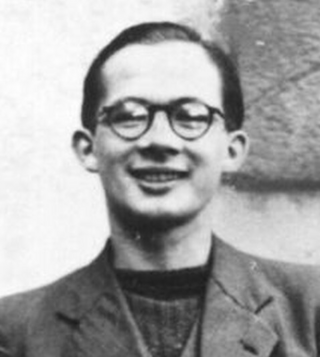
Marcel Callo was born in Rennes, France, as the second of nine children of Jean-Marie Callo, a French chemical plant worker, and Félicité Marie Josephe Callo. The working-class family was very religious, which is why his oldest brother later became a priest as well. During elementary school, Marcel Callo joined the altar servers and the Boy Scouts. In the latter organization, he was one of the first members of the group newly founded in Rennes in November 1933. Since financial constraints prevented him from attending a secondary school, he learned the trade of book printing and began working at a printing shop in 1934.
During this time, Marcel Callo joined the Catholic Workers’ Youth (KAJ). In 1938, he became the leader of a branch of the Catholic Workers’ Youth (KAJ) in Rennes. With the outbreak of war, it became increasingly difficult to continue his involvement with the Catholic Workers’ Youth (KAJ), and eventually, following France’s military defeat on August 28, 1940, and its partial occupation, the activities of the Catholic Workers’ Youth (KAJ) were banned. However, the youth leaders continued their work under the guise of sports clubs (which were not banned).
Starting in 1943, the situation in occupied France worsened, especially as the Allied air forces increasingly bombed French cities. During one such bombing raid on March 8, 1943, Rennes was hit, and Marcel Callo’s sister Madeleine was killed. It was Marcel Callo who found her lifeless body beneath the rubble.
On March 10, 1943, on the eve of Madeleine Callo’s funeral, Marcel Callo received his draft notice for the Labor Service in Germany. He left Rennes on March 19, 1943, to work at an armaments factory in Zella-Mehlis (south of Erfurt in Germany). Even in Germany, he had no intention of turning his back on his work for the Catholic Workers’ Youth (KAJ).
I'm leaving. We'll keep doing what we've been doing here. I think we'll do a good job. I'm going as a missionary.
Marcel Callos’s health suffered due to the working conditions and poor nutrition. Nevertheless, he organized church services there and established a Catholic Workers’ Youth (KAJ) organization in Zella-Mehlis. These activities did not go unnoticed by the Gestapo. On April 19, 1944, he and other members of the Catholic Workers’ Youth (KAJ) group around him were arrested by the Gestapo. Through their actions, the KAJ members had been working against National Socialism in Germany. This man is far too Catholic,
according to the Gestapo. The prisoners were taken to the city jail in Gotha. He wrote his last letter to his family on July 6, 1944. It clearly shows that the Gestapo was unable to break his faith.
There is a friend who never leaves me, even for a moment, and who stands by me. […] With him, one can endure anything.
On October 7, 1944, Marcel Callo was deported to the Flossenbürg concentration camp. From there, he was transferred to the Mauthausen concentration camp as early as October 25, 1944, and the next day to the Gusen I concentration camp. At first, he worked at the Gusen I concentration camp sorting aircraft rivets. On November 7, 1944, he was assigned to Gusen II concentration camp to work on the construction of a factory tunnel. Due to the appalling conditions in the concentration camps, he was admitted to the infirmary on January 5, 1945, with pulmonary tuberculosis, where he remained until January 20, 1945. After being discharged from the infirmary without having fully recovered, he contracted dysentery due to malnutrition and complete exhaustion. He died on March 19, 1945, at 2:00 a.m. from “circulatory failure and acute colitis.”
If I, an old “heretic” who saw thousands of prisoners die, was so impressed by this Marcel Callo, it was because there was something extraordinary about him. For me, it was a revelation: His gaze betrayed a deep conviction that he was moving toward happiness…
On October 4, 1987, Marcel Callo was beatified by Pope John Paul II in St. Peter’s Basilica. Among those present were a delegation from the Catholic Workers’ Youth of Austria (KAJ) and Austrian bishops.
Places
Persecution:
Death Place:
Honoring:
Citations
- Mikrut, Jan (2000): Blutzeugen des Glaubens. Martyrologium des 20. Jahrhunderts. Band 2 (Wien), p. 85–97.