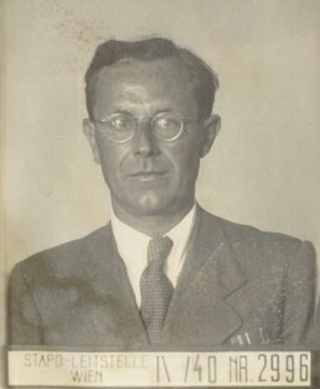
Hofrat DI Dr. Ernest Franz Otto Wilhelm Hippauf
Personalia
Born:
Died:
Profession:
Persecution:
Imprisonment 04.09.1940 - 02.09.1943
Memberships
Curriculum Vitae
Ernest Franz Otto Wilhelm Hippauf was born in Vienna as the legitimate son of the music teacher Otto Hippauf and his wife Helene, née Richter. His father died in 1907, whereupon his relative Franz Hippauf, a civil servant in the Vienna magistrate's office, took over his guardianship. After elementary school, he attended the Bundesrealschule 1070 Vienna [today: Bundesgymnasium und Bundesrealgymnasium Kandlgasse 30], where he graduated in 1922. In the same year, he enrolled in mechanical engineering at the Technical University in Vienna [today: Vienna University of Technology]. His studies were made possible by a scholarship from the Technical University and the municipality of Vienna. After his first state examination, he changed his field of study to electrical engineering and graduated as an engineer on June 28, 1927 [Note: After 1939, the title could be changed to Diplom Ingenieur.]
After graduating, Ernest Hippauf enrolled in doctoral studies at the Technical University and worked there as a research assistant. On December 23, 1929, he was awarded a doctorate in engineering for his dissertation on 'Investigation into the influence of moisture on flashover stress'. He then worked at Kabelfabrik- und Drahtindustrie AG until the end of 30 June 1931, after which he worked as a research assistant at the III Institute of Physics at the University of Vienna.
In 1935, Ernest Hippauf, who was a strict opponent of National Socialism, joined the Vaterländische Front and an organization close to it. On April 8, 1937, he finally began working at the Austrian Patent Office.
On March 12, 1938, the Austrian patriot Ernest Hippauf witnessed the demise of a free and independent Austria with the invasion of the German Wehrmacht. He remained hostile to the new rulers.
In early 1940, he was approached by his acquaintance Margarethe Jahoda, who knew of his aversion to National Socialism, and asked if he would like to join the Austrian Freedom Movement (ÖFB) around the Augustinian canon Roman Karl Scholz.
After taking the oath, Hans Ferdinand Zimmerl, Wolfdietrich Weis and Ernest Hippauf discuss the possibility of setting up secret radio stations. At a further meeting on July 2, 1940, they discuss the possibility of sabotaging automatic telephones.
Around this time, they succeeded, contact with the 'Austrian Freedom Movement' around Karl Lederer and the 'Großösterreichische Freiheitsbewegung' around the lawyer Jakob Kastelic.
From July 1940, a good 300 people from these resistance groups were betrayed by the castle actor Otto Hartmann (Otto Hartmann was subsequently sentenced to life imprisonment in 1947 and pardoned in 1957) and Ernest Hippauf was arrested by the Gestapo on September 4, 1940. He was released from custody on September 2, 1943.
Places
Residence:
Citations
Wiener Stadt- und Landesarchiv (WStLA)
Österreichisches Staatsarchiv (ÖStA)
Dokumentationsarchiv des österreichischen Widerstands (DÖW)
Archiv der Technischen Universität Wien
Matricula Online
Friedhöfe Wien - Verstorbenensuche