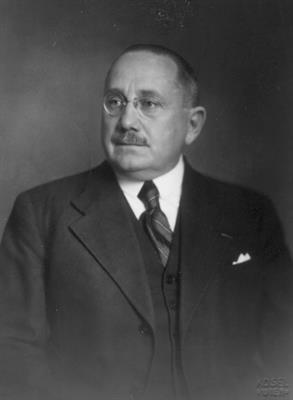
Magistratsdirektor Dr. Rudolf Josef Hießmanseder
Personalia
Born:
Died:
Profession:
Memberships
Curriculum Vitae
Rudolf Josef Hießmanseder [also Hiessmanseder] was born in Vienna as the legitimate son of the glass merchant Leopold Eduard Hießmanseder and his wife Maria, née Laska. After elementary school, he attended the k.k. State Grammar School in Oberhollabrunn. He was able to attend school thanks to a scholarship from the Lower Austrian governor's office. He graduated in 1900 and enrolled in law at the University of Vienna. In the same year, he joined the student association Norica.
Rudolf Hießmanseder received his doctorate in law in 1905 and began working in the district administration office for the 2nd district of Vienna. In 1906 he completed his military service. In 1908, he is involved in the founding of the student fraternities Marco-Danubia and Franco-Bavaria and becomes a member of both fraternities a year later. The name 'Franco-Bavaria' is suggested by him.
Rudolf Hießmanseder is not drafted into the First World War due to his state of health. During the war, he is Vienna's representative in the Lower Austrian People's Education Office and a member of the management of the People's Clothing Office of the Lower Austrian Governor's Office. In 1917, he moved to the municipal economic office (MA 44), where he was appointed head on June 13, 1922. In 1922 he married Emma Hafner and became the father of a daughter in 1923. After the death of Emma Hafner in January 1924, he married her sister Margarethe Hafner in September of the same year and became the father of a son in 1925.
As a result of the partial uprising of the Social Democratic Republican Protection League on February 12, 1934, the mayor and the other Social Democratic members of the Vienna City Senate and provincial government as well as the top Social Democratic civil servants were dismissed. On February 13, 1934, Federal Chancellor Engelbert Dollfuß, who was assassinated by the National Socialists in a coup attempt in July of the same year, Richard Schmitz was appointed Federal Commissioner for the City of Vienna (he later became Mayor). On the same day, Rudolf Hießmanseder is appointed by Richard Schmitz as Magistratsdirektor, and thus the highest official of the municipality of Vienna. He is also a member of the Vaterländische Front.
Appointed as municipal director by the Federal Commissioner [...], he was involved in the reorganization of the city administration [...]. The following should be emphasized: the organization of the difficult personnel issues after 12 February 1934, the organization of the Fatherland Front in the area of city administration, the creation of the city regulations, which created the basis for the appointment of the mayor, the deputy mayors and the Viennese citizenry [= municipal council, author's note], the reorganization of the Vienna City Council.], reorganization of the Vienna Magistrate [...] (creation of the Bezirkshauptmannschaften) [the Bezirksvorsteher were then Bezirkshauptmänner, author's note], involvement in the improvement of economic life in Vienna by changing the city's economic policy, in particular the involvement of private businesses, restructuring the tax system, drawing up extraordinary investment programmes. As Magistratsdirektor [...], Dr. Hießmanseder [...] is appointed to manage the entire internal service and acts as the Mayor's direct deputy, as the Magistrat's highest superior. In this capacity, he [...] is also responsible for the entire staff of the municipal companies. The number of employees and staff who report to him is around 42,700.
He died at the age of 60 due to a heart condition and found his final resting place at the cemetery in Vienna-Inzersdorf.
His son, named Rudolf Hießmansedern like his father, was later drafted and seriously injured in the war. He witnesses the liberation of Austria and the re-establishment of the Republic in April and May 1945 and, like his father, joins the Norica student fraternity as a student.
His widow Margarete Hießmanseder also witnesses the liberation of Austria and the re-establishment of the Republic and joins the newly founded Österreichische Volkspartei (ÖVP) and the ÖVP-Kameradschaft der politisch Verfolgten und Bekenner für Österreich
Places
Residence:
Citations
Wiener Stadt- und Landesarchiv (WStLA)
Österreichisches Staatsarchiv (ÖStA)
Biolex des ÖCV
Archiv der Universität Wien
Matricula Online
Friedhöfe Wien - Verstorbenensuche