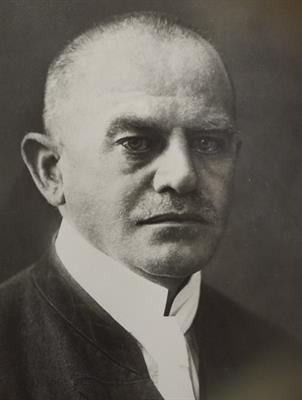
Josef Zwetzbacher
Personalia
Born:
Died:
Profession:
Persecution:
Imprisonment 1938–1939
Memberships
Curriculum Vitae
After graduating from secondary school and business school, Josef Zwetzbacher initially worked at his parents’ mill in St. Pölten-Stattersdorf. In 1897, he took over the “Zwetzbachermühle,” which had been in operation since 1679. He became involved in community affairs at a very early age, founding the “Volunteer Fire Department” in 1894 and also engaging in politics: in 1906, he was elected to the executive committee of the Lower Austrian Farmers’ Union; in 1908, he founded a Christian Social Association for farmers in the St. Pölten area. From 1909 to 1915, he served as a representative in the Lower Austrian State Parliament. During World War I, he served as a first lieutenant in the 12th Landsturm Brigade and, beginning in 1915, in the 59th Mountain Brigade.
After the war, he was elected the first freely elected mayor of Stattersdorf in 1918–1919. From 1918 to 1919, he was also a member of the Provisional State Assembly. In the first postwar elections, he was re-elected to the Lower Austrian State Parliament and served as a member from 1919 to 1925; from 1918 to 1920, he held the office of State Councilor and, from 1918 to 1925, also served as Deputy Governor. His successor in the state government was Josef Reither. From 1920 to 1925, he was also a member of the Federal Council and, at times, its chairman. In addition to these political offices, he served as president of the Lower Austrian Chamber of Agriculture beginning in 1922, as president of the Lower Austrian Farmers’ Bank from 1923 to 1924, and as a founding member of the “1st Lower Austrian Fire Damage Insurance Company.”
In 1923, the Pflug fraternity—founded two years earlier specifically for students at the University of Natural Resources and Life Sciences—named him an honorary member; he was also an honorary member of the Rhaeto-Norika Klosterneuburg fraternity.
In 1925, the National Socialists launched a campaign through the “Deutschösterreichische Tages-Zeitung,” a newspaper aligned with them, accusing him of misconduct in his roles at the “1st Lower Austrian Fire Damage Insurance Company” and the Lower Austrian Farmers’ Bank. Furthermore, he was accused of accepting bribes in connection with his many different positions. He subsequently resigned from all offices and positions—no doubt in part due to pressure from the CSP party leadership. He then returned to his business and served as president of the Vienna Commodity Exchange from 1934 to 1938.
After the Anschluss, he was arrested and convicted for having dismissed a worker without notice in July 1934 because of the worker’s National Socialist views, threatening him with a pistol, and “blackmailing” him with further sanctions when the worker attempted to assert claims for compensation.
Josef Zwetzbacher was a highly influential political figure and was named an honorary citizen of more than 50 municipalities in Lower Austria. He died in Vienna on December 25, 1942.
Citations
Krause, Peter/Reinelt, Herbert/Schmitt, Helmut (2020): Farbe tragen, Farbe bekennen. Katholische Korporierte in Widerstand und Verfolgung. Teil 2. Kuhl, Manfred (ÖVfStG, Wien) S. 411/412.
Photo: Biolex des ÖCV unter www.oecv.at/biolex; Stand: 22.10.2022.