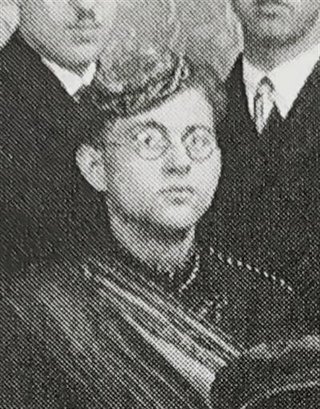
Dr. Otto Nuhr
Personalia
Born:
Died:
Profession:
Persecution:
Imprisonment at the Rudolstadt camp in Thuringia, March 27, 1938 – October 29, 1938
Memberships
Curriculum Vitae
Otto Nuhr was accepted into the Rhaetia Vienna secondary school fraternity in 1929. After graduating from high school in 1933, he studied medicine in Vienna. He had to pay for his studies “through his own work.” Regarding the last fraternity meeting “during a time of upheaval,” Otto Nuhr reports, among other things:
“At the time, we wanted to distribute the fraternity’s property among the brothers present so that each individual could save it from confiscation by hiding it safely. Suddenly, in the middle of our discussion, the younger son of our innkeeper, Stössel, burst in—dressed in full SS uniform—and declared us under arrest unless we dropped everything and left the hall immediately. I still managed to grab my cap, my colors, and the membership directory—which had been compiled just a few months earlier—along with the accompanying photo album, and make my escape.”
To protect everyone, he burned the membership roster. The next day, his home was searched. “Numerous interrogations followed at all sorts of locations in Vienna, since I refused to name my fraternity brothers.” “For illegal activity in a Catholic student fraternity” and because he did not reveal the names of the members, he was “taken by bus to Westbahnhof on March 27, 1938, without a word being said to us, and loaded onto a train that departed shortly thereafter. “In Rudolstadt, Thuringia, we were unloaded and taken to a camp surrounded by high barbed wire,” he writes in his resume. There, he was put to work on the Saale Dam until his release on October 29, 1938. He was then able to resume his studies and received his “Doctor of Medicine” degree in February 1939, after which he continued his training as an “assistant physician” at the Dombach Sanatorium.
From March 14, 1940, until he was wounded on March 25, 1940, Otto Nuhr was conscripted as a front-line laborer to work on the Westwall “on the Spicherer Heights under enemy fire.” On April 15, 1940, he was drafted into the German Wehrmacht, was seriously wounded several times, and was then deployed to Stalingrad “as a punitive measure on the orders of the military district physician,” “from where I emerged with a graze wound to the head.”
Further events leading up to the end of the war included a punitive transfer to East Prussia due to harassment by Nazi doctors; although he was discharged from the Wehrmacht as “unfit for service,” he was then forced to serve in the “Volkssturm” . Furthermore, on March 4, 1945, he was deployed to the Western Front, where he was assigned to “retreat operations.” In Halberstadt, Saxony-Anhalt, he was buried under rubble, wounded again, and subsequently taken as a prisoner of war by the Americans, from which he was released in June 1945. During his medical leave, he had been working as a doctor in Senfrenberg near Krems since 1940.
After the war, Otto Nuhr, together with his wife Rosemarie († 2012), founded the “Gesundheits-Zentrum” in Senftenberg in 1954—now known as the “Nuhr Medical Center”—thereby fulfilling a long-held dream. With the new treatment method he developed—high-frequency electrotherapy—he laid the foundation for specialization in trauma, neurological, and geriatric rehabilitation, as well as pain management.
Citations
Krause, Peter/Reinelt, Herbert/Schmitt, Helmut (2020): Farbe tragen, Farbe bekennen. Katholische Korporierte in Widerstand und Verfolgung. Teil 2. Kuhl, Manfred (ÖVfStG, Wien) S. 233/234.
Photo: Rhaeten-Chronik