Dr. Max Josef Metzger
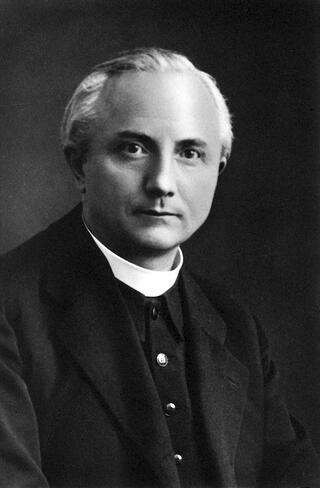
Personalia
Born:
Died:
Profession:
Persecution:
Imprisoned Jan. 23, 1934 (brief period),
Imprisoned Nov. 9, 1939 – Dec. 4, 1939,
Imprisoned June 29, 1943 – April 17, 1944,
Murdered April 17, 1944
Curriculum Vitae
Max Josef Metzger was born in Schopfheim in the Black Forest in South Baden (Germany) as the eldest son of a secondary school teacher. After completing his schooling in Schopfheim, Donaueschingen, and Lörrach, he entered a church-run boarding school in Konstanz, which at that time was directed by Conrad Gröber, who later became Archbishop of the Diocese of Freiburg. Beginning in 1905, he studied at the Faculty of Theology in Freiburg im Breisgau, and from 1908 onward in Fribourg, Switzerland, where he also wrote a recognized doctoral dissertation in church history on “Two Carolingian Pontificals from the Upper Rhine.” There he joined the Catholic temperance movement and from then on abstained from alcohol, nicotine, and meat.
Max Josef Metzger was ordained a priest in 1911 and subsequently served as a curate in Mannheim, Karlsruhe, and Oberhausen; however, his passionate commitment to the temperance movement led to resistance within the Church and the parish. During World War I, he served as a divisional curate on the French front. Deeply affected by his horrific wartime experiences, he became a radical pacifist while there. Together with Wilhelm Impekhoven, a priest of the Steyler Missionaries, he founded the World Peace Organization of the White Cross and the Peace League of German Catholics.
After World War I, Johannes Ude, a professor of speculative dogmatics at the University of Graz, brought him to Graz to work with him on establishing the temperance movement in the Styrian capital. Although Johannes Ude and Max Josef Metzger shared the same views on the substance of the matter, their personalities made collaboration impossible, whereupon Max Josef Metzger took over the leadership of the temperance movement.
In Graz, Max Josef Metzger, as secretary-general of the Kreuzbund, founded various Catholic organizations engaged in social and charitable work—including alcoholism rehabilitation and the temperance movement—and succeeded in recruiting laypeople and priests to work full-time for these causes. He was particularly active as a lecturer and as the author of numerous publications through the publishing house Volksheil, which he founded to promote his goals. In Styria, on the Feast of the Sacred Heart in 1919, the Mission Society of the White Cross—headquartered at Karmeliterplatz—emerged from the White Cross; through this organization, Max Josef Metzger organized his charitable efforts in the coming years, as well as the creation of new missionary and educational institutions and a Christian economic community. In 1928, Max Josef Metzger—who called himself “Brother Paulus”—relocated the organization, now known as the Christ the King Society, to Meitingen near Augsburg due to opposition—which was primarily related to the collapse of the cooperative he had significantly influenced—but returned to Graz several times to give lectures.
The St. Ulrichsbrunn Church in Graz-Andritz was run for decades by the Sisters of the Society of the Christ the King of the White Cross and thus served as a center of activity for Max Josef Metzger, as well as later for Michael Lerpscher and Josef Ruf, both of whom were murdered by the Nazis for “defying military conscription.” In the early years of his time in Graz, Max Josef Metzger celebrated communal Masses and Sunday services there on several occasions, which is why the local pastor, Josef Berghold, asked him on his deathbed in 1923 to ensure that the Society of the Christ the King would continue to run Ulrichsbrunn. This decision sparked resistance within the Graz church; opponents of the combative Metzger accused him of “inheritance-hunting”—though these allegations were never substantiated—and Ulrichsbrunn continued to operate, in accordance with Berghold’s wishes, as a place of pilgrimage and refuge for the suffering and the mentally ill. The Christ the King Society remained in Ulrichsbrunn until 1974, making it the place in Styria where Metzger’s legacy had the longest-lasting impact.
It was precisely Max Josef Metzger’s commitment to pacifism that ran counter to the National Socialists, who had already come to power in Germany in 1933. As early as January 23, 1934, he was imprisoned in Germany for a memorandum on church and state. Afterward, he and his activities were closely monitored by the Gestapo. From November 9, 1939, to December 4, 1939, he was imprisoned a second time, without any reason being given.
As Gestapo surveillance intensified, Max Josef Metzger moved in 1940 to the Piusstift of the Berlin Workers’ Parish of Wedding—a branch of the Christ the King Society located on Wildenowstraße—which had been established only four years earlier. In 1942, he drafted a private letter to Adolf Hitler in which he requested a cessation of hostilities; however, on the advice of a friend, he did not send it. That same year, he wrote a two-page memorandum to the Protestant Bishop von Eidem in Uppsala, in which he outlined a plan for the reorganization of Germany after the end of the war and asked the bishop to enter into negotiations with the Allies regarding a peace treaty.
He [Metzger] did this, driven by his conscience as an apostle of peace, who was obligated to work for justice and reconciliation among peoples—and, if necessary, to make sacrifices.
Max Josef Metzger was betrayed by a supposed confidant and arrested by the Gestapo on June 29, 1943. On September 11, 1943, he was transferred to Plötzensee Prison.
God has kept my heart joyful—surely through your intercession. I have entrusted everything to Him and offered my life for world peace and the unity of the Church—the two great causes that, as you know, are so deeply close to my heart.
On October 14, 1943, Max Josef Metzger was sentenced to death in a trial before the People's Court, presided over by its president Roland Freisler, in a hearing that lasted only 70 minutes and in which no witnesses were called.
I would just like to say once more that I have a clear conscience before God and my people, and that I sought only to serve them.
On October 22, 1943, Max Josef Metzger was transferred to Brandenburg-Görden and placed in a death cell measuring eight square meters. Since he realized that the trial was not “seeking justice” but was instead a show trial, he began praying for the judges even while the trial was still underway. On April 17, 1944, at 3:26 p.m., the death sentence was finally carried out. He was executed by guillotine.
Father, into Your hands I commit my spirit.
Max Josef Metzger was first buried in Brandenburg, exhumed on September 18, 1946, and laid to rest at St. Hedwig’s Cemetery in East Berlin. In 1968, his remains were transferred to Meitingen, where he was laid to rest.
On June 28, 1956, the Federal Court of Justice (Germany) ruled that the conviction and the execution of the death sentence constituted unlawful killing.
Citations
- Mikrut, Jan (2000): Blutzeugen des Glaubens. Martyrologium des 20. Jahrhunderts. Band 2 (Wien), p. 41–51.
Stolpersteine Graz unter www.stolpersteine-graz.at/stolpersteine/metzger-max-josef/
