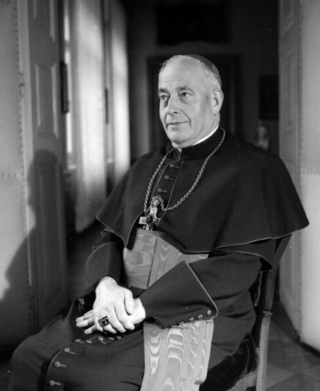
DDDr. Dr.h.c. Andreas Rohracher
Personalia
Born:
Died:
Profession:
Persecution:
Supported resistance fighters (without being discovered),
advocated for the surrender of Salzburg without a fight in 1945
Honors:
Honorary citizenship of the City of Salzburg
Memberships
Curriculum Vitae
Andreas Rohracher was born the son of Franz Rohracher, a Catholic-conservative member of the Imperial Council and an antiquarian bookseller; he graduated from the Cassianeum high school in Brixen in 1911. He then entered the Gurk Seminary due to a shortage of priests in Carinthia and studied at the Philosophical-Theological Institute in Klagenfurt. In 1915, he was ordained a priest in Tanzenberg.
Afterward, Andreas Rohracher served as a curate in Spittal/Drau for three years. In 1918, he was summoned to Klagenfurt by Bishop Adam Hefter of Gurk to serve as court curate and secretary to the diocesan ordinariate. As early as 1919, he went to Innsbruck to study (Dr. theol., 1922), then to Vienna (Dr. iur. utr., 1926), and finally to Rome (Dr. iur. can., 1927).
At the request of Adam Hefter, he was appointed titular bishop of Isba and auxiliary bishop of Gurk in 1933. In 1938, he was appointed vicar general.
On March 12, 1938, he witnessed the downfall of a free and independent Austria with the invasion of the German Wehrmacht. Following Adam Hefter’s resignation, Andreas Rohracher was elected vicar of the chapter on July 15, 1939. During the Third Reich, he protested against the killing of the mentally ill and against the attacks on Slovenes in Carinthia. On February 23, 1943, he was elected Prince-Archbishop by the Salzburg Cathedral Chapter. His translation (papal confirmation) took place on May 1, 1943. However, he remained administrator of the Diocese of Gurk until the new Bishop of Gurk, Josef Köstner, took office.
Through his brother Meinrad, Andreas Rohracher came into indirect contact with the “Antifascist Freedom Movement” (AFÖ), in which numerous members of the CVer played a leading role. He also had contacts with the “Kreisau Circle,” yet remained unharassed by the Gestapo. In Salzburg, the archbishop’s palace had been confiscated, so he found lodging at St. Peter’s Archabbey. In the final days of the war, he lobbied Gauleiter Adolf Scheel for the surrender of the city of Salzburg without a fight.
After the war, Andreas Rohracher advocated for reconciliation and warned the faithful against acts of revenge against Nazis, a stance that also drew criticism. In 1951, on the instructions of the Holy See, he relinquished the title “Prince-Archbishop.” That same year, he was admitted to the Order of the Holy Sepulcher of Jerusalem (OESSH). From 1951 to 1955, he served as prior of the Salzburg Commandery of the Order of the Holy Sepulcher of Jerusalem (OESSH), and from 1954 to 1967, he served as Grand Prior of the Austrian Lieutenancy.
He was equally committed to renewing youth ministry, to Catholic Action (KA), to Caritas Austria, and to the “Save Life” campaign. From 1955 to 1959, following the death of Cardinal Theodor Innitzer, he served as chairman of the Austrian Bishops’ Conference.
Under his leadership, the Catholic University Association—which also organizes the Salzburg University Weeks—founded the “International Research Center for the Foundations of Science” in 1961. In 1965, Andreas Rohracher made the widely noted proposal to create a separate patriarchate for the churches of the Reformation, with the aim of revitalizing ecumenical dialogue.
On June 20, 1969, his resignation was accepted. After stepping down, he spent his final years at the Capuchin monastery in Altötting until his death.
Places
Place of activity:
Citations
Biolex des ÖCV unter www.oecv.at/biolex
Archiv Ritterorden vom heiligen Grab zu Jerusalem (OESSH)
Wikipedia unter de.wikipedia.org/wiki/Andreas_Rohracher